- Mumbai, Gangtok, New Delhi, Bangalore
- (+91) 81518 30000
- WhatsApp Now
- contact@vedawellnessworld.com
VEDA REHABILITATION AND WELLNESS
Evidence-Based Trauma & Addiction Treatment in the Himalayas
Most therapeutic approaches ask you to talk about what happened. EMDR therapy asks something different: it asks your brain to finish processing what it never could.
Eye Movement Desensitisation and Reprocessing (EMDR) is an evidence-based psychotherapy developed by Dr Francine Shapiro in the late 1980s and now recognised by the World Health Organisation (WHO), the UK’s National Institute for Health and Care Excellence (NICE) and the American Psychological Association (APA) as a first-line treatment for trauma and PTSD.
The clinical premise is grounded in neuroscience. Traumatic experiences — whether a single catastrophic event or years of accumulated stress — can overwhelm the brain’s natural memory-processing systems. When this happens, the memory becomes stored in a raw, unprocessed form: vivid, intrusive and emotionally charged. The brain cannot distinguish between then and now. EMDR therapy directly targets these stuck memories.
EMDR does not require you to describe the trauma in detail or practise confronting it repeatedly. It works by engaging bilateral brain stimulation — typically guided eye movements — while you hold the memory in mind, allowing the brain’s own processing mechanisms to complete what trauma interrupted
Most therapeutic approaches ask you to talk about what happened. EMDR therapy asks something different: it asks your brain to finish processing what it never could. Eye Movement Desensitisation and Reprocessing (EMDR) is an evidence-based psychotherapy developed by Dr Francine Shapiro in the late 1980s and now recognised by the World Health Organisation (WHO), the UK’s National Institute for Health and Care Excellence (NICE) and the American Psychological Association (APA) as a first-line treatment for trauma and PTSD.
The clinical premise is grounded in neuroscience. Traumatic experiences — whether a single catastrophic event or years of accumulated stress — can overwhelm the brain’s natural memory-processing systems. When this happens, the memory becomes stored in a raw, unprocessed form: vivid, intrusive and emotionally charged. The brain cannot distinguish between then and now. EMDR therapy directly targets these stuck memories.
The result, documented across more than 30 randomised controlled trials, is a reduction in the emotional and physiological charge attached to traumatic memory — not the erasure of the memory, but the removal of its power to destabilise the present.
EMDR is recommended by the World Health Organisation as a first-line treatment for PTSD in adults and children — one of only two psychological therapies to hold this status globally
In a key RCT, 60% of participants no longer met diagnostic criteria for PTSD after eight sessions of EMDR — with outcomes maintained at 12-month follow-up. (van den Berg et al., 2018 / Journal of Traumatic Stress, 2024)
Up to 45% of people entering addiction treatment meet criteria for co-occurring PTSD — the population for whom integrated EMDR addiction treatment produces the strongest outcomes. (BMC Psychiatry, peer-reviewed)
EMDR therapy is supported by more than 30 published randomised controlled trials, placing it among the most rigorously evaluated psychological therapies available worldwide.
EMDR therapy India is most established as a treatment for post-traumatic stress disorder (PTSD). This includes single-incident trauma — road accidents, medical emergencies, assault, sudden bereavement — and complex, chronic trauma arising from childhood adversity, prolonged abuse or cumulative professional exposure (first responders, medical professionals, executives in high-stakes environments). For many patients who have found talking therapies insufficient or re-traumatising, EMDR trauma treatment India offers a clinically distinct route.
The link between unresolved trauma and addiction is one of the most consistent findings in clinical psychiatry. Substances — alcohol, opioids, stimulants, benzodiazepines — frequently begin as self-medication for intrusive memories, hyperarousal, emotional numbing or chronic shame rooted in traumatic experience. EMDR addiction treatment addresses this root driver directly, rather than treating the substance use in isolation. A 2022 meta-analysis (Journal of EMDR Practice and Research) synthesising data from 561 participants across 9 studies found EMDR to be effective across a range of substance use disorder outcomes. Programmes that integrate EMDR addiction treatment within broader dual diagnosis care produce stronger and more durable recovery outcomes than addiction-only approaches.
EMDR therapy has demonstrated significant reductions in anxiety and depression symptoms across multiple clinical trials. It is particularly relevant for presentations where anxiety or depression is rooted in specific adverse life experiences — chronic perfectionism, performance failure, relationship trauma, professional humiliation or identity-disrupting events — rather than purely neurochemical in origin. For executives and professionals presenting with burnout alongside a trauma history, EMDR forms one component of Veda's integrated dual diagnosis framework
EMDR therapy India at Veda Rehabilitation and Wellness is not offered as a standalone module or a bolt-on treatment option. It is integrated — where clinically appropriate — within a fully individualised residential treatment programme designed by a consultant psychiatrist and delivered by accredited EMDR therapists.
This distinction matters. EMDR is a phased protocol. The processing phases that achieve therapeutic change depend on a stable psychological foundation established in the earlier phases. Programmes that skip stabilisation and move directly to trauma processing expose patients to unnecessary distress and compromise outcomes. At Veda, the full eight-phase EMDR protocol is delivered within a clinically safe residential environment that allows the stabilisation, processing and integration phases to be completed without interruption.
The Eight Phases of EMDR at Veda
A thorough clinical assessment identifies target memories, current triggers and the most clinically productive processing sequence. This phase integrates with Veda's broader psychiatric and dual diagnosis assessment.
The patient is introduced to the EMDR model, bilateral stimulation techniques and emotion regulation tools. In residential treatment, this phase is supported by the full therapeutic environment — group work, somatic therapies and daily clinical structure.
The specific traumatic memory selected for processing is assessed across its sensory, cognitive and emotional dimensions. A negative belief associated with the memory is identified alongside its preferred positive alternative.
Desensitisation, Installation, and Body Scan The core processing phases: guided bilateral stimulation is applied while the patient holds the target memory. Sets of eye movements continue until the memory's emotional charge reduces and the preferred positive belief is consolidated. A body scan confirms complete processing.
Each session ends with a structured return to emotional equilibrium. Between sessions, the patient uses self-regulation tools practised in phase two. The residential setting provides immediate clinical support if needed.
At the start of each subsequent session, the previous target is re-evaluated to assess stability of processing before any new work begins.
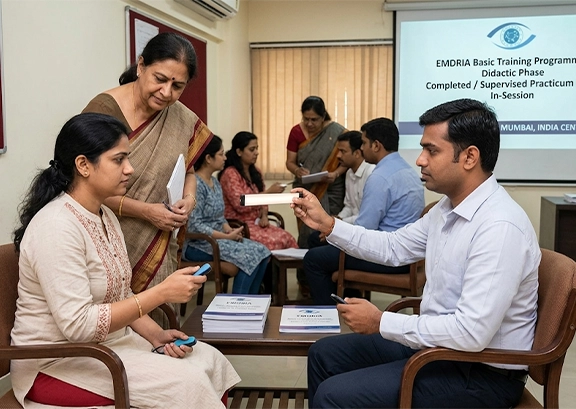
EMDR therapy in India requires clinical training that is specific to the modality and ongoing in scope. At Veda Rehabilitation and Wellness, EMDR is delivered exclusively by therapists who meet the following credentialing standards:
EMDR therapy (Eye Movement Desensitisation and Reprocessing) is a structured, evidence-based psychotherapy that uses bilateral brain stimulation, most commonly guided eye movements, to help the brain reprocess traumatic memories that have become stuck. Unlike traditional talking therapies, EMDR does not require you to describe the trauma in detail or practise repeatedly confronting it. The therapeutic mechanism operates at a neurological level, reducing the emotional charge of distressing memories rather than building cognitive coping strategies around them. EMDR therapy India at Veda Rehabilitation and Wellness is conducted by accredited therapists within a residential clinical framework, not as a standalone outpatient session.
Yes. EMDR is one of only two psychological therapies recommended by the World Health Organisation as a first-line treatment for PTSD. It is also endorsed by NICE (UK), the American Psychological Association, and the US Department of Veterans Affairs. More than 30 randomised controlled trials support its effectiveness, and clinical data show that a significant proportion of patients no longer meet PTSD diagnostic criteria after completing a course of EMDR. At Veda, EMDR trauma treatment India is delivered within the full eight-phase protocol and integrated with broader psychiatric and dual diagnosis care.
EMDR addiction treatment addresses one of the most clinically significant drivers of substance use: unresolved trauma. Research consistently shows that up to 45% of people entering addiction treatment meet criteria for co-occurring PTSD. Substances frequently function as self-medication for intrusive memories, hyperarousal or chronic shame rooted in trauma. By processing the underlying traumatic memories, EMDR reduces the psychological pressure that sustains addictive behaviour. A 2022 meta-analysis found EMDR to be effective across substance use disorder outcomes including reduced craving and improved psychological functioning. At Veda, EMDR is integrated within a comprehensive dual diagnosis programme, not offered in isolation.
EMDR therapy India is available at a small number of specialist clinical facilities, but few offer the full residential context that the complete eight-phase protocol requires. At Veda Rehabilitation and Wellness, EMDR is embedded within a private residential rehabilitation programme in Sikkim, in the Himalayan foothills, a clinical and environmental setting designed to support psychological processing. Therapists are trained to EMDRIA-recognised standards. Treatment is overseen by a consultant psychiatrist and delivered within the confidentiality protections of India’s Mental Healthcare Act, 2017. For those travelling from metropolitan India or from abroad, the residential Himalayan setting offers both clinical depth and geographical distance from everyday triggers. Choose a moment when the person is calm and sober. Use specific observations rather than labels, describe what you have seen and how it has affected you and the family. Express care as the foundation: this conversation is coming from love, not contempt. Have a specific next step ready, not ‘you should get help’ but ‘I have found a place we can speak to together, will you come with me?’ Contact Veda’s admissions team for guidance on preparing for this conversation.
The number of sessions required depends on the complexity and nature of what is being processed. Single-incident trauma may respond within 6–12 sessions. Complex trauma, dissociative presentations, or addiction-related trauma processing within a dual diagnosis framework typically requires longer work. At Veda, EMDR is not delivered as a fixed-session module. The treating psychiatrist and EMDR therapist assess progress continuously, and the programme is adjusted accordingly. The residential setting allows intensive scheduling not possible in outpatient contexts, compressing the clinical timeline while maintaining safety.
It is clinically normal to experience some emotional activation between sessions as the brain continues processing. This is why Veda’s approach prioritises the preparation and stabilisation phases, ensuring patients have the emotion regulation tools to manage inter-session processing before trauma-focused work begins. The residential environment means that clinical support is immediately available. EMDR is not initiated until the treating team determines that the patient is sufficiently stable. The goal throughout is to make processing as safe, gradual, and clinically contained as possible. We do not promise specific outcomes, but we do promise that safety is the primary criterion at every stage.
Yes. Veda Rehabilitation and Wellness regularly treats NRI and international patients seeking EMDR trauma treatment India as part of a residential programme away from their professional and social networks. Pre-admission assessments are available via encrypted telehealth. Medical travel documentation is facilitated through a discreet third-party service. Extended programme durations are available for international patients. All aftercare correspondence and follow-up consultations are conducted via encrypted channels. Enquiries can be made by telephone, email, or WhatsApp, as listed below, all communications are handled in full clinical confidence.