How Screen Addiction is Harming Children: India’s Top Doctors Explain

  • Home
  • Addiction
  • How Screen Addiction is Harming Children: India’s Top Doctors Explain

A toddler crying in a restaurant used to be comforted with a toy, a story or a hug.

Today, many children are handed a phone.

A cartoon starts playing. The child becomes silent. The parents feel relieved.

It seems harmless.

But doctors across India and globally are becoming increasingly concerned about what excessive screen exposure is doing to children’s brains, emotions, sleep, communication skills and development.

Because this generation is growing up differently from any generation before it.

Many children today are being exposed to screens before they even properly learn language.

Before they fully understand facial expressions. Before they learn patience. Before their brains finish wiring basic attention and emotional response systems.

And experts say this may come with consequences we still do not fully understand.

Children are getting hooked before their brain is ready

The human brain develops rapidly during the first five years of life.

This is when children learn:

  • language
  • emotional regulation
  • attention span
  • social interaction
  • problem solving
  • empathy
  • adaptability

Doctors repeatedly stress that young children learn best through real world interaction.

Not passive screen exposure.

They need:

  • eye contact
  • touch
  • conversations
  • outdoor play
  • physical movement
  • human reactions
  • social experiences

But screens are increasingly replacing these experiences.

According to multiple pediatric studies globally, children are now being introduced to smartphones and tablets as early as infancy.

In many households, screens are used during feeding, calming, travel, bedtime and tantrums.

Parents often say:

“Otherwise he doesn’t eat.”

“Only cartoons calm her down.”

“He cries if we take the phone away.”

That may seem like short term convenience. But over time, it can slowly condition the child’s brain to depend on constant digital stimulation.

India’s Pediatricians are raising concerns

Many child psychologists, neurologists and developmental pediatricians in India have publicly expressed concern about rising screen dependency among children.

The concerns are not only about “too much entertainment.”

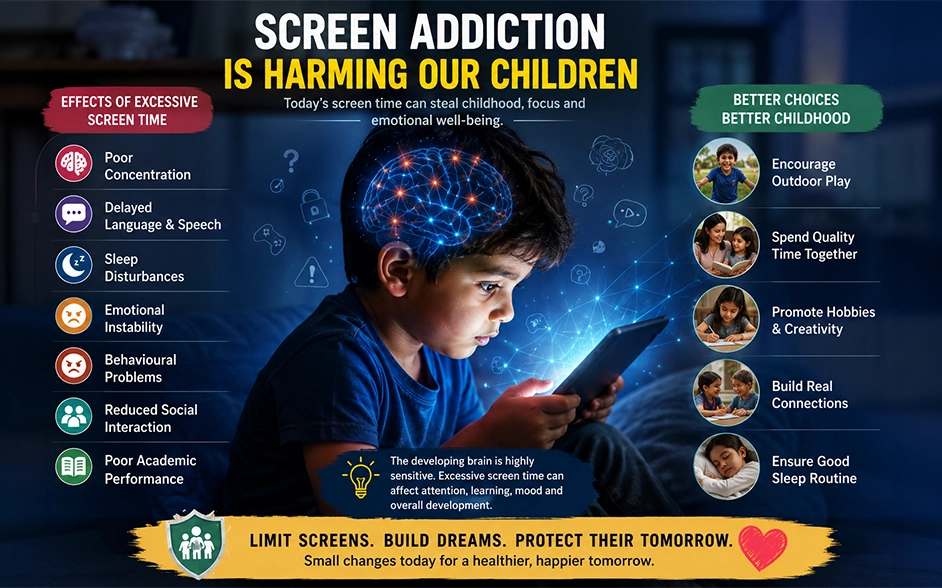
Doctors are now seeing children with:

  • shorter attention spans
  • delayed speech
  • emotional dysregulation
  • irritability
  • sleep disturbances
  • reduced social interaction
  • behavioural difficulties
  • poor frustration tolerance

Some pediatric clinics have even observed cases informally referred to as “virtual autism-like symptoms” linked to excessive early screen exposure, though this is not an official medical diagnosis.

Experts strongly caution parents not to confuse screen related developmental delays with Autism Spectrum Disorder (ASD), because ASD is a complex neurodevelopmental condition with strong genetic influences.

But they also acknowledge that environmental and behavioural factors may affect child development and behaviour significantly.

What is ASD exactly?

Autism Spectrum Disorder (ASD) is a neurodevelopmental disorder that affects brain development.

Children with ASD may experience:

  • communication difficulties
  • social interaction challenges
  • repetitive behaviours
  • restricted interests
  • sensory sensitivities

Research strongly supports a genetic predisposition in autism.

However, scientists also study epigenetic and environmental influences that may affect gene expression and neurodevelopment.

This is where confusion often begins online.

Current scientific evidence does NOT prove that screen time directly causes autism.

But several researchers and pediatric experts have raised concerns that excessive screen exposure during critical developmental years may worsen communication difficulties, social disengagement and behavioural symptoms in vulnerable children.

This distinction is extremely important.

Screen addiction is not considered a proven cause of ASD. But unhealthy developmental environments may influence behavioural outcomes and developmental patterns in children.

The brain learns through human interaction

Children do not only learn words. They learn emotions.

A child learns emotional intelligence by:

  • watching facial expressions
  • listening to tone of voice
  • observing body language
  • playing with others
  • handling disappointment
  • adapting socially

Screens cannot fully teach these things.

A cartoon does not pause for a child’s confusion. A video does not build real emotional reciprocity. An algorithm cannot replace human bonding.

This is one reason many experts worry that excessive screen dependence may reduce adaptability in children.

And adaptability matters.

Because intelligence is not only memory or academic scores.

True intelligence includes adapting to change, handling discomfort, solving social problems and emotionally regulating oneself in unpredictable situations.

Some experts now worry that children raised with constant instant stimulation may struggle more with patience, boredom and emotional flexibility later in life.

Emotional regulation is declining

One of the biggest concerns globally is emotional regulation.

Children today are growing up in environments of nonstop stimulation.

Fast videos.
Quick rewards.
Bright visuals.
Constant novelty.

The brain slowly gets used to high dopamine stimulation.

Then ordinary life begins to feel “boring.”

Doctors increasingly report that many children struggle with:

  • frustration tolerance
  • boredom
  • delayed gratification
  • patience
  • sitting quietly
  • independent play

This often shows up as:

  • tantrums
  • irritability
  • emotional outbursts
  • anger when screens are removed
  • difficulty focusing in classrooms

Parents frequently describe situations where children become aggressive or inconsolable when denied devices.

This is not simply “bad behaviour.”

The brain may begin associating screens with emotional soothing and reward regulation.

Over time, dependency can develop.

Sleep Disorders are rising globally

Sleep experts worldwide are also sounding alarms.

Excessive screen use before bedtime is strongly associated with poor sleep quality in children and adolescents.

Blue light exposure may interfere with melatonin production, the hormone that regulates sleep.

Late night screen stimulation can also keep the brain emotionally activated.

As a result, many children today experience:

  • delayed sleep
  • reduced sleep quality
  • shorter sleep duration
  • daytime fatigue
  • mood disturbances
  • concentration difficulties

And poor sleep affects almost everything else:

  • memory
  • emotional regulation
  • immunity
  • academic performance
  • mental health

Several studies now show rising sleep disturbances globally among children and teenagers with high screen exposure.

Are Educational Apps making children smarter?

Technology itself is not the enemy.

Used properly, digital tools can support education, creativity and learning.

But many experts worry that over dependence on educational technology may sometimes reduce independent thinking and real world learning experiences.

In the past, children learned through:

  • physical exploration
  • social play
  • asking people questions
  • outdoor experiences
  • real conversations
  • observation

Today, many children receive instant answers from devices.

The concern is not that technology teaches children.

The concern is whether excessive dependence may reduce curiosity, patience and problem solving abilities over time.

Some educators now report that children increasingly struggle with:

  • sustained attention
  • deep reading
  • critical thinking
  • face to face communication
  • independent problem solving

Technology should ideally support thinking. Not replace it.

Why Parents accidentally reinforce Screen Addiction

Modern parenting is exhausting.

Many parents are overworked, stressed and mentally drained.

Screens often become survival tools.

A child is not eating? Play cartoons.

A child is crying? Give the phone.

Parents need to work? Hand over the tablet.

This is understandable. Not evil parenting.

But repeated screen based soothing teaches the brain something powerful:

Discomfort should immediately disappear.

Real life does not work that way.

Children eventually need to learn:

  • patience
  • boredom tolerance
  • emotional self soothing
  • frustration management
  • delayed gratification

Without these skills, emotional resilience weakens.

Social Skills may quietly decline

One hidden effect of excessive screen exposure is reduced real world social learning.

Children who spend excessive hours online may have fewer opportunities to develop:

  • eye contact
  • conversational timing
  • empathy
  • teamwork
  • conflict resolution
  • emotional awareness

Digital interaction is often controlled and predictable.

Human interaction is not.

And children need real world unpredictability to develop emotionally.

What do Health Guidelines actually recommend?

The World Health Organization (WHO) and pediatric associations globally recommend limiting screen exposure for very young children.

WHO guidelines suggest:

  • No sedentary screen time for children under 1 year
  • Very limited screen exposure for children aged 2 to 5 years
  • More emphasis on active play, sleep and human interaction

The American Academy of Pediatrics also recommends strong limits and encourages high quality, supervised content instead of passive unlimited exposure.

The goal is not zero technology forever.

The goal is healthy balance.

Warning Signs of Screen Addiction in Children

Parents should pay attention if a child:

  • becomes extremely distressed without devices
  • loses interest in offline activities
  • struggles with sleep
  • avoids social interaction
  • has worsening concentration
  • becomes aggressive when screen time ends
  • constantly demands devices
  • shows emotional withdrawal
  • cannot self entertain without screens

Early intervention matters.

Because habits built during childhood often continue into adolescence and adulthood.

Emotional connection must be rebuilt

Addiction often disconnects families emotionally.

People stop sharing feelings. Conversations become transactional or tense.

Family therapy helps rebuild:

  • Emotional safety
  • Empathy
  • Compassion
  • Emotional closeness

Rebuilding emotional connection creates a support system that protects recovery.

What can parents actually do?

Experts usually recommend gradual changes instead of sudden punishment.

Some healthier approaches include:

Create Screen-Free Zones

Keep bedrooms, dining tables and family time device free whenever possible.

Encourage Real Play

Outdoor activity, sports, art, storytelling and physical play help brain development.

Avoid Using Screens as Emotional Rewards

Children should not learn that every emotional discomfort requires digital escape.

Model Healthy Behaviour

Children copy adults. Parents constantly on phones unintentionally normalize screen dependence.

Prioritize Human Interaction

Simple conversations, eye contact, reading together and family routines matter more than many people realise.

Screens are now deeply woven into modern life. They are not disappearing.

But childhood itself is changing because of them.

Many children today are learning to swipe before they properly learn to communicate. They are being exposed to digital stimulation during the exact years when their brains are still building the foundations of attention, language, adaptability and emotional regulation.

Technology can educate. It can entertain. It can support learning.

But childhood development still fundamentally depends on human interaction.

On touch.
Conversation.
Play.
Patience.
Connection.
Boredom.
Real life experiences.

The concern many doctors now share is not that children use screens.

It is that screens are increasingly replacing experiences the developing brain was biologically designed to need.

And that difference may shape an entire generation.

FAQs

Can excessive screen time delay speech in children?

Some studies suggest excessive passive screen exposure in very young children may be associated with delayed language development, especially when it replaces human interaction and conversation.

No scientific evidence proves that screen time directly causes autism spectrum disorder (ASD). ASD is a complex neurodevelopmental condition strongly linked to genetic factors. However, excessive screen exposure may affect communication and behaviour in some children.

Screens stimulate dopamine reward pathways in the brain. Over time, some children may become emotionally dependent on this stimulation, leading to irritability or tantrums when devices are removed.

Health organizations recommend very limited screen exposure for young children, especially under age 5, along with more focus on play, sleep and human interaction.

Yes. Excessive screen exposure, especially before bedtime, is associated with poor sleep quality, delayed sleep and emotional irritability in children and teenagers.

Not necessarily. High quality educational tools can support learning. Problems usually arise when screens replace physical play, human interaction and independent thinking for long periods.

Leave A Comment

Your email address will not be published. Required fields are marked *