The Loneliness Economy: Why India Is Paying to Feel Less Alone

  • Home
  • Addiction
  • The Loneliness Economy: Why India Is Paying to Feel Less Alone

There was a time when loneliness looked different.

It looked like an old man sitting alone on a park bench. It looked like a widow eating dinner in silence. It looked like someone isolated from society.

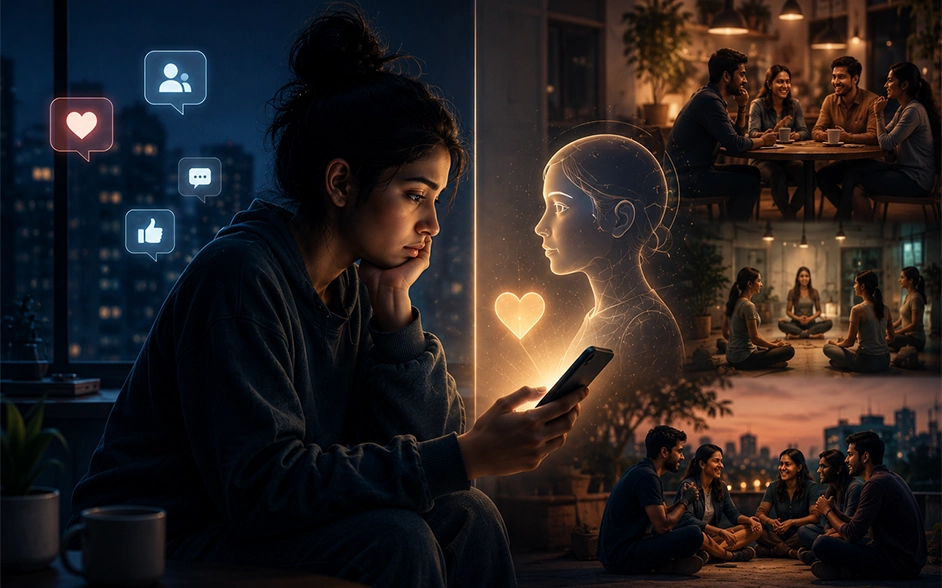
Today, loneliness looks like a 23-year-old scrolling Instagram at 2:13 AM with 4,000 followers. It looks like someone replying instantly in five WhatsApp groups but having nobody to call during a panic attack. It looks like couples sitting at restaurants staring at their phones instead of each other.

We are living in the most digitally connected era in human history. And somehow, many people have never felt more emotionally disconnected.

The numbers are now becoming impossible to ignore.

According to the World Health Organization (WHO), around 1 in 6 people globally experience loneliness. In 2025, the WHO Commission on Social Connection reported that loneliness is linked to more than 871,000 deaths annually worldwide. That is roughly 100 deaths every single hour.

This is no longer just a personal feeling. It is becoming a public health issue. It is also becoming one of the fastest growing industries in the world.

Welcome to the loneliness economy.

What is the Loneliness Economy?

The loneliness economy refers to the growing market of products, services, apps and experiences designed to help people feel emotionally connected, comforted, seen or less alone.

This includes:

  • AI companion apps
  • Mental health platforms
  • Dating apps
  • Online therapy
  • Parasocial creator communities
  • Virtual friendships
  • Live streaming platforms
  • Gaming communities · Wellness retreats
  • Co working cafés
  • Social clubs
  • Emotional support subscriptions

Experts estimate the global loneliness economy could cross 140 billion dollars by 2030.

And India is becoming one of its biggest growth markets.

Because India is changing very fast.

More Screens, More Followers, Less Connection

India has over 900 million internet users today. The average urban young adult spends several hours daily on screens through Instagram, YouTube, gaming, OTT platforms, dating apps and messaging platforms.

But social media has quietly changed the definition of connection.

Platforms reward visibility. Not intimacy.

They count:

  • Likes
  • Views
  • Streaks
  • Comments
  • Engagement
  • Followers

But they cannot measure:

  • Emotional safety
  • Trust
  • Loyalty
  • Genuine friendship
  • Belonging

The platform counts your interactions. Not your relationships.

And that difference matters.

Several global studies now show that excessive social media use is associated with higher rates of anxiety, loneliness, poor sleep and low self esteem, especially among adolescents and young adults.

Ironically, Indian youth with some of the highest social media usage patterns often score poorly on belonging and wellbeing metrics.

India’s youth mental health quotient has also ranked poorly in global comparisons in recent years, reflecting rising emotional distress, burnout, social pressure and psychological fatigue among young people.

The result?

People are constantly surrounded by digital noise but emotionally starving.

Why Urban India feels more alone than ever

One of the biggest reasons loneliness is growing in India is urban migration.

For decades, India’s emotional safety net came from:

  • Joint families
  • Neighbourhood friendships
  • Extended relatives
  • Local communities
  • Cultural gatherings
  • Familiar social structures

But modern urban life disrupted that system.

Millions of young Indians move from small towns to cities like Mumbai, Bengaluru, Delhi, Pune and Hyderabad every year for education and work.

When they move, something invisible often breaks.

Their support system.

Parents stay behind.
School friends scatter.
Neighbourhood familiarity disappears.
Festivals become video calls.
Conversations become shorter.

Eventually, silence becomes normal.

Many young professionals today live in expensive apartments surrounded by thousands of people but emotionally disconnected from almost everyone.

Work stress increases.
Commutes get longer.
Relationships become transactional.
And emotional exhaustion quietly builds in the background.

India’s rapid urbanisation created economic opportunity. But it also weakened traditional community structures that protected emotional wellbeing.

Why people are turning to AI Companions

Over the last five years, AI companion apps have exploded globally.

Apps like entity “mobile_app”,“Replika”,“AI companion app”, Character.AI and other conversational AI platforms now attract millions of users.

People use them for:

  • Emotional support
  • Companionship
  • Stress relief
  • Late night conversations
  • Relationship simulation
  • Venting without judgment
  • Comfort during anxiety

Some users even describe their AI companion as their “best friend.”

That sounds strange at first. Until you understand what people are actually seeking.

Not necessarily technology.

But emotional presence.

One of the most discussed examples is entity “mobile_app”,“Replika”,“AI companion app” Pro.

User surveys and testimonials over the years have shown that many users reported reduced anxiety, improved mood and emotional comfort while interacting with AI companions.

For some individuals, especially people struggling with social anxiety, grief, loneliness or isolation, these apps can temporarily reduce emotional distress.

And science is beginning to examine this seriously.

A joint OpenAI and MIT Media Lab research effort found that moderate conversational AI use may reduce feelings of loneliness for some users.

But the same research also warned about something important.

Heavy daily emotional dependence on AI interactions correlated with greater isolation and reduced real world human interaction.

That distinction matters.

Using AI occasionally as a supportive tool is very different from emotionally replacing human relationships.

AI Companions are not evil. But they are not neutral either.

This conversation often becomes extreme.

Some people say AI companions are dangerous. Others say they are the future of emotional support.

Reality is usually more complicated.

AI companions are tools.

In some ways, they are not very different from:

  • Journaling
  • Meditation apps
  • Self help books
  • Voice notes
  • Therapy exercises

For some people, they may genuinely help reduce distress.

But there is another side.

When a product is specifically designed to feel like a friend, partner or emotional safe space, the line between tool and dependency can blur very fast.

Especially for emotionally vulnerable users.

Unlike real relationships, AI companionship offers:

  • Instant validation
  • No conflict
  • No rejection
  • No emotional unpredictability
  • Constant availability

Human relationships do not work that way.

Real connection involves discomfort, compromise, patience and emotional effort.

That is why experts increasingly worry that emotionally immersive AI systems could slowly replace difficult but necessary human interactions.

And when loneliness meets convenience, convenience usually wins.

The business of emotional need

The loneliness economy is not growing because companies suddenly became compassionate.

It is growing because loneliness creates demand.

Emotionally disconnected people spend more time online.
They consume more content.
They seek comfort.
They seek belonging.
They seek distraction.

That creates massive commercial opportunity.

Today, entire industries are built around emotional engagement.

Dating apps profit from prolonged usage.
Social platforms profit from attention.
Streaming platforms profit from binge watching.
AI companion apps profit from emotional attachment.

Some platforms now intentionally design systems around emotional retention.

Notifications.
Typing bubbles.
Voice intimacy.
Memory recall.
Personalized emotional responses.

The goal is simple.

Keep the user emotionally engaged for longer.

This is where the loneliness economy becomes ethically complicated.

Because helping people feel connected is valuable.

But monetising emotional dependence is different.

Why young people are especially vulnerable

Young adults today are growing up in an emotionally unusual environment.

They are exposed to:

  • Constant comparison
  • Digital validation systems
  • Hyper productivity culture
  • Unstable relationships
  • Financial pressure
  • Social media perfection
  • Declining face to face interaction

At the same time, many lack strong emotional education.

Schools teach mathematics. Very few teach:

  • Emotional regulation
  • Conflict management
  • Loneliness coping skills
  • Healthy communication
  • Relationship boundaries
  • Digital wellbeing

As a result, many young people become emotionally overstimulated but relationally underdeveloped.

They know how to text. But not always how to connect.

That emotional gap is becoming a serious mental health issue.

Loneliness is not just emotional. It is biological.

Loneliness affects the brain and body more than most people realise.

Research has linked chronic loneliness with:

  • Depression ·
  • Anxiety disorders
  • Sleep problems
  • Cardiovascular disease
  • Weakened immunity
  • Cognitive decline
  • Increased stress hormones
  • Higher mortality risk

The WHO now considers social connection an important public health priority.

Because human beings are biologically wired for connection.

The brain interprets prolonged social isolation as danger.

That is why loneliness can physically hurt.

And this is why replacing all human connection with digital interaction may create unintended long-term consequences.

India’s silent mental health shift

India is currently experiencing a psychological transition that few people openly discuss.

For years, survival and financial growth dominated the national conversation.

Now emotional wellbeing is slowly entering mainstream discussion.

More Indians are talking about:

  • Therapy
  • Burnout
  • Anxiety
  • Emotional exhaustion
  • Loneliness
  • Boundaries
  • Mental health

This is positive.

But the speed of social change is also creating emotional confusion.

Traditional family systems are weakening.
Modern support systems are still underdeveloped.
And digital substitutes are filling the gap faster than society can fully understand their impact.

That is why India is becoming a major market for emotional technology.

People are not just buying convenience anymore.

They are buying emotional relief.

So what is the solution?

There is no simple solution to loneliness.

But one thing is becoming increasingly clear.

Human beings do not only need communication. They need meaningful connection.

Not every problem requires deleting technology. Technology itself is not the enemy.

The real question is balance.

AI companions, social media and digital communities can sometimes help people feel supported.
But they should not completely replace:

  • Family relationships
  • Close friendships
  • Real conversations
  • Physical community
  • Emotional vulnerability
  • Human presence

Healthy technology should support human life. Not quietly replace it.

Small things that actually reduce loneliness

Ironically, the solutions that work best are often the least glamorous.

Research consistently shows that loneliness reduces through:

  • Face to face interaction
  • Community participation
  • Volunteering
  • Meaningful friendships
  • Support groups
  • Physical activity
  • Shared experiences
  • Emotional openness

Even simple habits help:

  • Eating meals with people
  • Walking without headphones sometimes
  • Calling instead of texting occasionally
  • Joining hobby groups
  • Spending less passive screen time
  • Having emotionally honest conversations

Connection is built slowly.
Not downloaded instantly.

The future of human connection

The loneliness economy will continue growing.
Probably very fast.

AI companions will become more intelligent.
Virtual emotional experiences will become more immersive.
Digital relationships will feel increasingly real.

But one uncomfortable question will remain.

If technology becomes better at simulating connection, will society become worse at practicing it?

That may become one of the biggest psychological questions of the next decade.

Because the danger is not that people are talking to machines.

The danger is that many people no longer feel emotionally safe talking to other humans.

And that says something important about modern life.

The loneliness economy did not appear by accident.
It emerged because millions of pe

More screens.
More followers.
More digital conversations.
Yet many people still go to sleep feeling emotionally alone.

India is now standing at the centre of this emotional shift.

A rapidly urbanising population.
Massive digital adoption.
Changing family structures.
Rising mental health awareness.
And an entire generation trying to figure out connection in a hyperconnected world.

AI companions and emotional technology may help some people temporarily feel heard. But no algorithm can fully replace what human connection does to the nervous system, the mind and the heart.

The future probably will not be about rejecting technology. It will be about learning how to use it without losing ourselves inside it.

Because at the end of the day, people are not truly searching for notifications. They are searching for belonging.

FAQs

What is the loneliness economy?

The loneliness economy refers to industries and digital platforms that profit from helping people feel emotionally connected, supported or less alone. This includes AI companion apps, therapy platforms, dating apps, online communities and wellness services.

Loneliness in India is rising due to urban migration, weakening family structures, work stress, excessive screen time, social media dependency and reduced face to face interaction.

Not necessarily. Moderate use may help some people reduce anxiety or emotional distress. However, experts warn that heavy emotional dependence on AI companions may increase social isolation if they begin replacing real human relationships.

Chronic loneliness is associated with anxiety, depression, sleep problems, low self esteem, stress and emotional exhaustion. Long term loneliness may also affect physical health.

Yes. While social media increases communication, excessive use can sometimes increase comparison, emotional disconnect and feelings of isolation, especially when online interaction replaces real life relationships.

Building meaningful friendships, joining communities, exercising, volunteering, spending time with family, attending support groups and having honest conversations are some of the most effective ways to reduce loneliness naturally.

Leave A Comment

Your email address will not be published. Required fields are marked *