- Mumbai, Gangtok, New Delhi, Bangalore
- (+91) 81518 30000
- WhatsApp Now
- contact@vedawellnessworld.com
If you are reading this, you are probably exhausted. You have watched someone you love change in ways that frighten you. You have had the arguments, the promises, the moments of hope that didn’t last. And now you are here, searching for what to actually do next. This page is for you.
India has over 16 crore people who consume alcohol, with more than 5.7 crore living with harmful or dependent use. Yet only 2.6% of alcohol-dependent individuals have ever received any treatment. Most families are carrying this alone — not knowing where to turn, not sure how to help without making things worse
You are not alone. And there are concrete, evidence-based things you can do
Before we talk about what to do, it helps to understand what you are actually facing. This matters because it changes how you approach everything that follows. Addiction is not a character flaw, a lack of willpower or a choice your loved one is making to hurt the family. It is a chronic medical condition that involves measurable changes in brain chemistry and structure — specifically in the circuits that govern reward, decision-making and self-awareness.
This is why people with addiction often cannot simply ‘decide to stop.’ The part of the brain responsible for recognising the problem and making rational long-term decisions is precisely the part that addiction most disrupts.
Understanding this does not mean accepting harmful behaviour without limits. It means the approach that works is different from what most families instinctively try first.
Families often wait far longer than they should — sometimes years — before seeking professional support.
The most common reason is uncertainty: Is this serious enough? Maybe it will get better on its own.
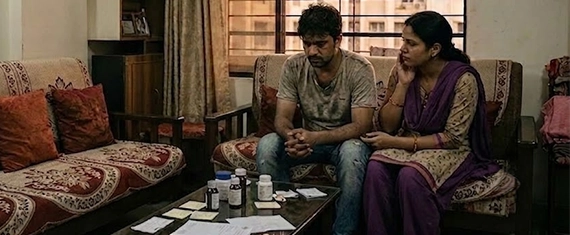
Here are the signs that professional help is needed. The more of these that apply, the more urgent the situation is.
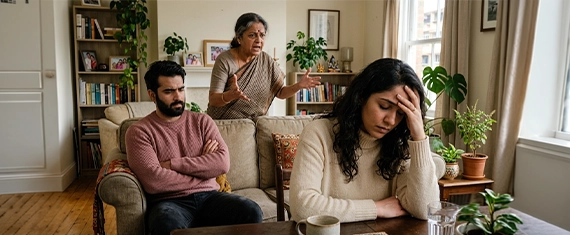
Most families try to help by confronting, pleading, arguing or issuing ultimatums. These approaches are understandable. They are also, most of the time, counterproductive — because addiction operates through denial, shame and defensiveness and direct confrontation tends to activate all three.
The approach that research consistently shows to be more effective is known as the CRAFT model — Community Reinforcement and Family Training. Developed and extensively studied over three decades, CRAFT trains family members in specific communication strategies that reduce resistance and increase the likelihood of the person accepting help.
Research shows that when families use CRAFT principles, their loved one enters treatment approximately 64–75%
of the time — two to three times higher than traditional confrontational interventions.
The core principles, simplified:
Talk at the right moment
Have the conversation when the person is sober and calm — not in the middle of an argument, not immediately after an incident. The moment matters.
Be specific about what you have observed
Talk about specific incidents and their impact, not about character. Describe what you saw and how it affected you and the family.
Express care alongside concern
The conversation should make clear that your concern comes from love, not contempt. ‘I love you and I am worried about you’ is not soft — it is strategically correct.
Have a specific ask, with a specific option ready
‘Will you speak with someone?’ is easier to resist than ‘I have spoken to Veda and they can speak with us this week — will you come with me?’ The more concrete the next step, the easier it is to say yes.
What to do if they refuse
A first refusal is not a final answer. Many people in recovery name a specific conversation — one they initially rejected — as the moment that planted a seed. Contact Veda’s admissions team directly: we regularly help families plan their approach.
When someone agrees to get help — even tentatively, even with conditions — move quickly and calmly. This is the window that matters.

Researching and selecting a centre in advance means that when the person agrees, you are ready. Hesitation or delay at this stage can allow the person's defences to rebuild.

Giving the person some agency — a choice between two suitable centres, a say in the timing — reduces the sense of helplessness that can cause people to back out.

Our admissions team handles this stage with families regularly. We can speak confidentially with you and, if the person is willing, arrange a direct conversation with a clinical team member.
For families, the admission process can feel daunting. Here is what it actually involves at Veda, clearly and without medical jargon
On arrival, the person is assessed by a psychiatrist and clinical team. This is a thorough conversation designed to understand the full picture: the substance use history, any co-occurring mental health conditions, physical health and what the person needs. At Veda, the majority of clients presenting for addiction treatment have a co-occurring mental health condition such as depression or anxiety. The assessment identifies this so treatment addresses the whole person from day one.
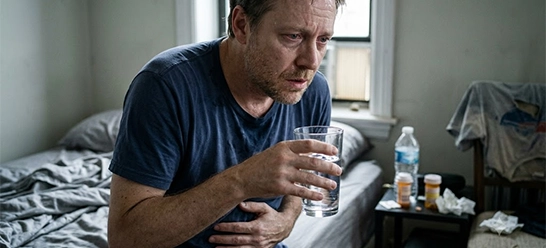
If the person has been using alcohol heavily or is dependent on benzodiazepines, a medically supervised detox is often the first step. This is conducted within Veda's clinical environment with 24-hour medical support. Families should know that alcohol withdrawal can be medically serious — this is not the kind of detox that should be attempted at home.
Once medically stable, the person moves into the residential programme. In the early days, contact with the outside world is typically structured and limited. This is not rejection; it is a clinical decision designed to allow the person to settle without distraction. The team will keep you informed about progress.
At Veda, the family is not a peripheral concern — it is part of the treatment. This reflects both the clinical evidence and the reality of India’s family structures, where addiction almost never affects just one person. Veda’s family therapy programme includes
Psychoeducation sessions
These help family members understand addiction as a medical condition — how it develops, how it affects the brain, why certain patterns play out and what recovery actually involves. Families who understand the condition are better equipped to support recovery without unintentionally enabling it.
Structured family therapy
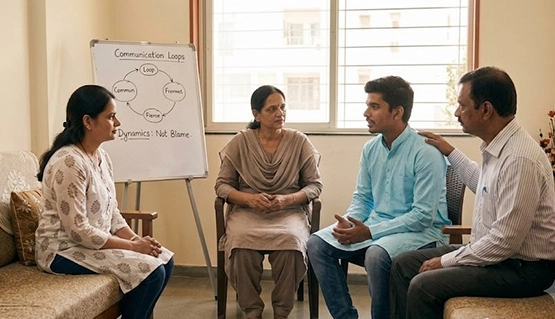
Regular facilitated sessions involving the client and key family members. The goal is not to assign blame — it is to identify the dynamics and communication patterns in the family that may be maintaining the problem, and to develop healthier ones. Research consistently shows that including the family in treatment produces better long-term recovery outcomes.
These two things look similar from the outside but are very different in effect. Giving money to someone who will use it to buy alcohol is enabling, not supporting. Covering up incidents to protect the family’s reputation is enabling. These patterns are human and understandable — and they can be changed with the right guidance.
Support for family members themselves
Families of people with addiction carry their own burden of anxiety, grief, anger and hypervigilance. Veda’s team works with family members on their own wellbeing — not as a footnote, but as a clinical priority.
When someone agrees to get help — even tentatively, even with conditions — move quickly and calmly. This is the window that matters.

Attend every family session offered. Ask questions. Bring your concerns. The treatment team wants you involved

Al-Anon (for families of people with alcohol use disorder) and Nar-Anon (for families affected by drug dependency) hold regular meetings across India's major cities and online. Many family members find these groups transformative.

Caring for someone through addiction is traumatic. It is not unusual for family members to develop anxiety, depression or sleep disorders. These are real conditions and they deserve real support. Speak to a counsellor, therapist or your own GP.

This is the pattern where family members become so focused on the person with addiction that their own lives and wellbeing become secondary. Understanding and gradually breaking this pattern is necessary — both for you and for the recovery of the person you love.
Start by contacting a centre like Veda directly — the admissions team regularly guides families through exactly this situation. The most effective approach is not confrontation but a carefully prepared conversation using evidence-based communication principles (the CRAFT model). Research shows that with this approach, loved ones enter treatment at a rate of 64–75%. Identify a centre in advance, document specific incidents and prepare a specific, concrete ask rather than a general request to ‘get help.’
In India, the Mental Healthcare Act 2017 generally protects an individual’s right to make decisions about their own treatment. Involuntary admission is possible in limited circumstances where the person poses a serious risk to themselves or others, typically requiring a formal psychiatric assessment and legal process. The more effective and sustainable path for most families is voluntary treatment supported by a well-prepared family conversation, ideally guided by a clinical team. Contact Veda’s admissions team to discuss your specific situation confidentially.
Key indicators include: inability to stop or reduce despite repeated attempts; physical withdrawal symptoms when not using; substance use causing significant harm to health, relationships, finances or work. If you are asking whether it is serious enough, it almost certainly warrants a professional assessment. The cost of seeking advice when it turns out to be less serious is very low. The cost of waiting when it is serious is very high.
Veda actively involves the family in the treatment process. After an initial settling-in period, families participate in orientation sessions, receive regular updates from the clinical team, and attend structured family therapy sessions. We also support family members who need to process their own experiences during this time. The family is not asked to simply wait — you are part of the treatment.
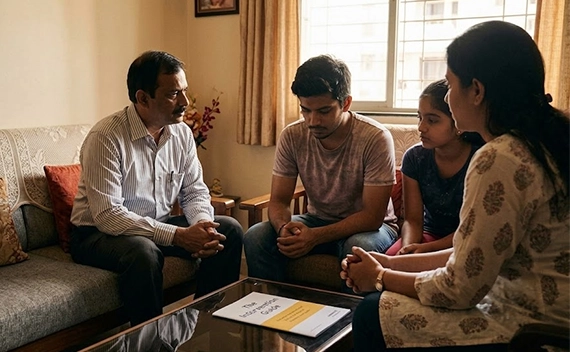
Choose a moment when the person is calm and sober. Use specific observations rather than labels — describe what you have seen and how it has affected you and the family. Express care as the foundation: this conversation is coming from love, not contempt. Have a specific next step ready — not ‘you should get help’ but ‘I have found a place we can speak to together, will you come with me?’ Contact Veda’s admissions team for guidance on preparing for this conversation.
Yes. You can contact Veda’s admissions team at any stage — you do not need to wait until your loved one has agreed to treatment. We regularly speak with families who are in the earlier stages of trying to help and can offer guidance on how to approach the conversation, what to expect from treatment and how to support both yourself and your loved one through this process.
Attend all family sessions offered by Veda’s clinical team. Seek your own support through counselling, peer support groups like Al-Anon, or your own GP. Learn about addiction as a medical condition: the more you understand, the better equipped you will be to support recovery when your loved one comes home. Resist the urge to make major family decisions or have high-stakes conversations until the person has had time to stabilise in treatment.