- Mumbai, Gangtok, New Delhi, Bangalore
- (+91) 81518 30000
- WhatsApp Now
- contact@vedawellnessworld.com
If you are looking up the cost of rehab in India, you are probably doing it for someone you love — or for yourself. Either way, this page will give
you real numbers, clear explanations of what drives the price and the tools to ask the right questions before you commit.
The short answer: private rehab in India can cost anywhere from ₹30,000 to over ₹5,00,000 per month, depending on the type of
centre, the city, the level of clinical care and what is — and is not — included in the quote.
The longer answer is what this guide is for.
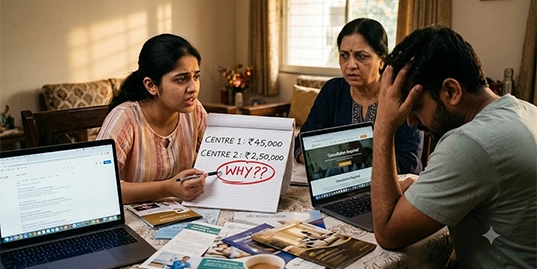
Most families researching rehabilitation centres run into the same problem: the prices look wildly different and nobody explains why. One centre quotes ₹45,000 a month. Another in the same city says ₹2,50,000. A third refuses to give a number until after a paid consultation.
The confusion is real and sometimes deliberate. Understanding what drives genuine cost differences and what to watch out for, is the first step to making a clear-headed decision

These are the most affordable option — often free or heavily subsidised. India's National Drug Dependence Treatment Centre (NDDTC) and state-run de-addiction centres exist in most major cities.
Cost: Free to ₹5,000 per month
The trade-off: long waiting lists, limited psychiatric staff, minimal individual therapy and facilities that vary significantly in quality. For someone needing immediate, intensive, medically supervised care — particularly for complex cases involving dual diagnosis — these facilities are often insufficient.

A step above government facilities, these are privately run, offer residential accommodation, group therapy and basic medical supervision. Standards vary enormously.
Cost: ₹20,000 – ₹60,000 per month
Common limitations: high patient-to-staff ratios, limited psychiatric involvement, few individual therapy sessions and often no structured aftercare plan.

These offer full residential care with structured daily programmes, access to a psychiatrist, individual and group counselling, and a more clinical approach to treatment.
Cost: ₹60,000 – ₹1,50,000 per month
The quality within this range varies. Some are genuinely strong clinically. Others use the price point without the clinical depth to match it. Ask about staff credentials, psychiatrist availability and whether dual diagnosis is treated.

These centres offer private accommodation, low client-to-staff ratios, integrated psychiatric and addiction care, evidence-based therapy programmes, holistic support and discretion. They are designed for professionals, executives and families who need clinical excellence alongside privacy and comfort.
Cost: : ₹1,50,000 – ₹5,00,000+ per month
The price reflects genuine differences in staffing, clinical depth, programme structure and outcomes. Luxury rehab in India remains a fraction of what comparable treatment costs internationally — in the US or UK, the equivalent would run USD 15,000–50,000 per month
| Centre Type | Monthly Cost (INR) | Psychiatrist Access | Individual Therapy | Aftercare |
|---|---|---|---|---|
| Government / NGO | Free – ₹5,000 | Limited | Minimal | Rarely Included |
| Basic Private | ₹20,000 – ₹60,000 | Periodic | 1–2 Sessions / Week | Optional Add-on |
| Mid-Range Private | ₹60,000 – ₹1,50,000 | Regular | 3–5 Sessions / Week | Varies |
| Premium / Luxury | ₹1,50,000 – ₹5,00,000+ | Full-time On-site | Daily | Structured & Included |
When you receive a quote from any private rehab centre in India, these are the things that should be included as standard — not billed separately
Included in a fair, transparent quote:
Family sessions priced separately | Medical Detox supervision | Aftercare and relapse support sold as optional extras | “Room upgrades” that quietly double the stated price | Post-admission cost revisions once a patient has settled in
For current pricing, please visit our pricing page, where you will find a clear breakdown of what each programme includes.
What we can say here:

Our all-inclusive residential programme rates are transparent no hidden fees, no post-admission revisions

Every programme includes psychiatric assessment, individual therapy, group therapy, family counselling and a structured aftercare plan.

Detox at Veda, where required, is part of the programme not billed separately.

Our Sikkim centre offers an additional layer of geographic discretion for clients who require it.
This is a fair and important question. The answer is yes — and the reasons are measurable
Staffing ratios matter clinically
At lower-cost centres, one psychiatrist may oversee 30–50 patients. At premium centres, the ratio is significantly lower, meaning the clinical team has meaningful time with each individual. In addiction treatment, therapeutic relationship quality is one of the strongest predictors of outcome.
Dual diagnosis treatment requires specialist capacity
India’s national clinical data shows that between 32% and 74% of people presenting for addiction treatment have a co-occurring mental health condition — most commonly depression or anxiety. Treating addiction without addressing the underlying mental health condition is associated with significantly higher relapse rates. This integrated, simultaneous treatment model requires full-time psychiatric staff and trained dual diagnosis clinicians. It costs more to run — but it produces substantially better outcomes than treating one condition at a time.
Aftercare is where recovery is protected
The period of highest relapse risk is the 2–6 months after discharge. Centres that include structured aftercare in their programme design — regular follow-up, relapse prevention planning, family support — show meaningfully better long-term outcomes. This is a clinical investment, not a luxury.
Programme length affects recovery
Across published clinical research, longer residential programmes — 60 to 90 days rather than 28 — are consistently associated with better long-term sobriety outcomes. Premium centres are more likely to offer and recommend appropriate programme durations rather than defaulting to the shortest (and cheapest) option.
What is the all-in cost for the full planned duration — including detox, medication, therapy, family sessions and aftercare?
How many patients does each psychiatrist manage?
How many individual therapy sessions will the patient receive per week?
Is dual diagnosis assessed and treated simultaneously?
What does the aftercare programme look like and is it included in the fee?
What are the qualifications of the clinical and counselling team?
Veda’s admissions team is available to discuss your situation, answer questions about our programmes and provide clear
pricing — without requiring you to come in first.
Or call our admissions team directly. There is no obligation. There is no pressure. There is just a conversation.
General Awareness Disclaimer: This guide provides general information about rehabilitation costs in India for educational purposes. It does not constitute medical advice. If you or someone you know is experiencing addiction or a mental health crisis, please consult a qualified medical professional or psychiatrist for a proper assessment and treatment recommendation.
Sources: National Survey on Extent and Pattern of Substance Use in India 2019 (AIIMS/NDDTC); Mental Healthcare Act 2017, Government of India; Veda Rehabilitation & Wellness Internal Enquiry Data 2024–2026 (anonymised aggregate); NIMHANS Dual Diagnosis Clinical Data 2015–2024; market pricing data from publicly available rehabilitation centre sources, verified June 2026
Private rehabilitation centre costs in India range from ₹20,000 to over ₹5,00,000 per month depending on the type of centre, location and level of care. Basic private centres typically charge ₹20,000–₹60,000 per month. Mid-range centres fall between ₹60,000 and ₹1,50,000. Premium and luxury residential rehabilitation programmes typically begin at ₹1,50,000 per month and go higher based on programme duration, accommodation type and clinical intensity
A fair, all-inclusive rehab fee should cover accommodation, meals, medical detox supervision (where required), psychiatric assessment and ongoing care, individual therapy, group therapy, standard medications, family counselling and an aftercare plan. Many lower-cost centres exclude one or more of these particularly medications, family sessions and aftercare, which can significantly change the true total cost.
Yes, in most cases for the right reasons. Higher-cost programmes typically offer lower patient-to-staff ratios, full-time on-site psychiatric care, integrated dual diagnosis treatment and structured aftercare. These are not comfort extras; they are clinical variables that affect recovery outcomes. Nationally, clinical data shows 32–74% of addiction patients have a co-occurring mental health condition, meaning integrated care is not optional but essential for sustainable recovery.
Most residential rehab programmes in India start at 28–30 days (one month). However, clinical evidence consistently shows that longer programmes, 60 to 90 days produce significantly better long-term sobriety outcomes. Premium centres are more likely to recommend appropriate programme lengths rather than defaulting to the minimum.
Under India’s Mental Healthcare Act 2017, insurers are legally required to provide coverage for mental health conditions on par with physical health. However, actual reimbursement for rehabilitation and de-addiction treatment varies significantly by insurer and policy. It is advisable to check directly with your insurer before admission. Ask your chosen centre whether they assist with insurance coordination.
Do not compare headline monthly rates compare all-in programme costs for the full planned duration. Ask each centre to confirm in writing what is and is not included. Specifically ask about: detox fees, medication costs, family session charges, aftercare costs and whether the quoted rate can change after admission. A centre that is confident in its pricing will answer these questions clearly and in writing.
High-quality residential rehabilitation in India costs a fraction of equivalent programmes in the US, UK or Singapore. International programmes comparable in clinical quality and amenities to India’s premium centres typically cost USD 15,000–50,000 per month (approximately ₹12–40 lakh). India’s premium programmes offer the same clinical standards at significantly lower cost, which is why a growing number of NRI families and international clients choose to access treatment in India.