- Mumbai, Gangtok, New Delhi, Bangalore
- (+91) 81518 30000
- WhatsApp Now
- contact@vedawellnessworld.com
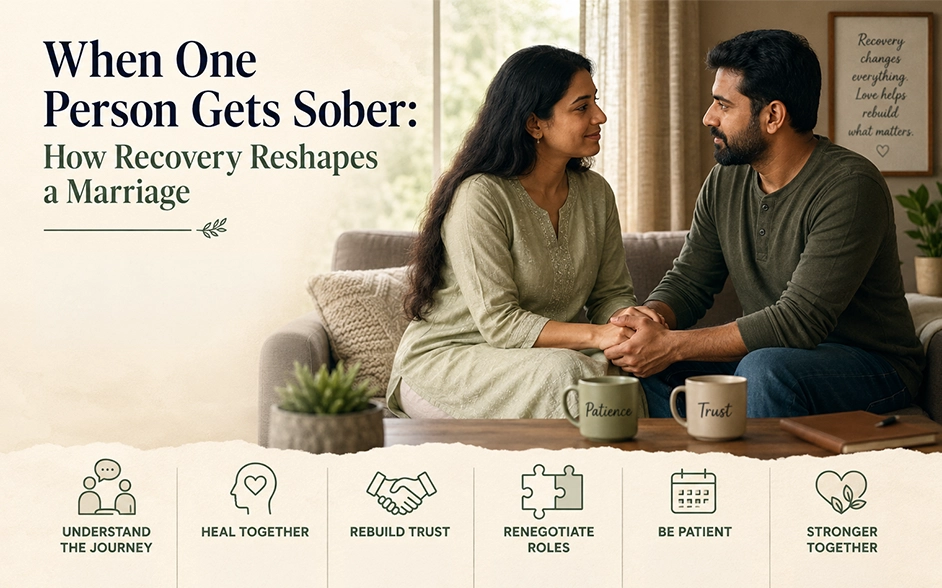
Priya remembers the exact week her husband came back from a 90-day treatment programme. She had spent three years bracing for his drinking. Now she found herself bracing for something she hadn’t expected at all: a sober husband she barely knew how to talk to.
“I thought getting him sober was the hard part,” she said. “Nobody told me that was just the start.”
This is one of the least talked-about parts of addiction recovery in India. Families focus, understandably, on getting the person into treatment. Far less attention goes to what happens afterward, inside a marriage, once the addiction that organised so much of daily life is no longer there. Recovery doesn’t hand a couple their old relationship back. It hands them a new one and both people have to learn how to build it.
Every marriage affected by addiction develops its own quiet architecture around the substance use. One partner drink or uses; the other manages, covers, predicts and adjusts. Plans get made around whether the using partner will be in a state to attend. Conversations get avoided because they might trigger a drinking episode. Over time, the non-using spouse often becomes the one holding the household together, financially and emotionally, without ever being asked to take on that role outright.
Indian research backs up how heavy this load becomes. A study published in the Indian Journal of Medical Research, led by researchers at PGIMER Chandigarh, found that family caregivers of men with alcohol or opioid dependence reported moderate to severe burden in 95 to 100% of cases, most heavily in disrupted family routines, financial strain and disrupted family interactions and leisure. Separate Indian studies have found that psychiatric morbidity, largely depressive symptoms, affects an estimated 63 to 66% of spouses of men with alcohol dependence. The person who isn’t drinking is often carrying nearly as much psychological weight as the person who is.
This matters because it explains something that surprises a lot of couples: sobriety doesn’t automatically undo that architecture. The habits, roles and defences built over years of managing addiction don’t dissolve the day the drinking stops.
Families often expect recovery to bring instant relief. What frequently shows up instead is a strange kind of grief and disorientation on both sides.
The person in recovery is learning to feel things they used to numb, often for the first time in years. Anger, boredom, sadness and stress all arrive without the buffer they’re used to. This can make them harder to live with in the short term, not easier, even though the underlying change is a positive one.
Meanwhile, the spouse who spent years in crisis mode often doesn’t know how to stand down from it. Trust, once broken by addiction, doesn’t rebuild on the same timeline as sobriety. A spouse might find themselves still checking the odometer, still smelling a partner’s breath, still bracing for a relapse that hasn’t happened. This isn’t a lack of faith in the relationship. It’s a nervous system that spent years learning to stay alert, now being asked to relax on command.
Resentment also tends to surface in recovery in a way it couldn’t during active addiction, when survival took priority over processing. Old wounds, financial damage, missed milestones and broken promises often come up for the first time months into sobriety, not before it.
The good news, and it is genuinely good news, is that marriages affected by addiction can and do heal, and there is solid research behind what helps that happen.
Behavioural Couples Therapy, developed and extensively studied by researchers including Timothy O’Farrell and William Fals-Stewart, is one of the most well-evidenced approaches in this space. It has been designated an established, strong-evidence treatment by the American Psychological Association and is listed on the US government’s national registry of evidence-based programmes. Reviews covering more than twenty controlled studies show it improves not just substance use outcomes but also relationship satisfaction and it measurably reduces domestic violence within couples where one partner has a substance use disorder.
Involving the spouse or family in the recovery process itself, not just in therapy afterward, also makes a measurable difference. A study conducted at an Indian addiction treatment centre and published in the Journal of Studies on Alcohol and Drugs found that involving family members in relapse prevention meaningfully improved outcomes for alcohol-dependent patients. This lines up with what clinicians increasingly understand: recovery that happens in isolation from the marriage is harder to sustain than recovery that includes it.
A few things tend to come up again and again in couples who successfully rebuild.
Both partners need their own support, not just the one who used substances. The non-using spouse has usually absorbed their own trauma over the years and needs space to process it, whether through individual therapy, a support group like Al-Anon or structured family counselling. Recovery that focuses only on the addicted partner leaves half the couple unsupported.
Rebuilding trust works better as a series of small, consistent actions than as one grand gesture. Spouses who’ve been lied to for years don’t rebuild trust because someone says the right thing once. They rebuild it slowly, through months of a partner doing what they said they’d do.
New roles need to be renegotiated, not assumed. Many spouses who ran the household alone during active addiction struggle to hand parts of that back, even when their partner is ready and able to take them on. This isn’t stubbornness. It’s a habit built over years, and it usually needs an honest conversation rather than silent resentment on either side.
And timelines need to be realistic. Clinical experience and research both point to the same thing: rebuilding a marriage after addiction typically takes longer than the treatment itself. Early sobriety is a beginning, not a finish line.
Couples who work through this well often describe something unexpected: a marriage that, while harder-won, is more honest than the one addiction allowed. Communication that used to route around the substance now has to happen directly. Conflict that used to get drowned out gets addressed instead. It isn’t the marriage either partner signed up for, but many describe it as a stronger one, built on choices made in clear-headed daily life rather than on habits formed around a substance.
Not every marriage survives addiction, and pretending otherwise would be dishonest. But for couples willing to treat recovery as something they’re doing together rather than something happening to one of them, the research and the clinical experience both point in a hopeful direction.
At Veda Rehabilitation and Wellness, family and couples’ involvement is built into treatment planning from the start, not added on afterward. Whether it’s the partner of someone entering treatment or a couple trying to rebuild months into sobriety, that support is treated as part of the recovery itself, not a separate concern.
There’s no single number that applies to every couple, and reliable India-specific data on this is limited. What research does show clearly is that outcomes improve significantly when spouses are involved in the recovery process rather than left out of it, and that structured approaches like couples therapy measurably improve both sobriety and relationship satisfaction.
This is common and doesn’t mean something is wrong. Early sobriety often brings emotions that were previously numbed, along with old resentments and unresolved issues surfacing for the first time. It’s a difficult but expected phase of genuine recovery, not a sign that things are going backward.
Behavioural Couples Therapy is a structured, evidence-based approach that treats the couple as a unit during recovery. Research reviewing more than twenty controlled studies has found it improves substance use outcomes, relationship satisfaction, and reduces domestic violence, and it’s recognised by the American Psychological Association as an established, strong-evidence treatment.
Trust tends to rebuild gradually, through consistent, reliable behaviour over time rather than through one conversation or apology. Most couples find it easier with professional support, since old patterns of suspicion and defensiveness are hard to unlearn alone.
Yes. Research on families affected by addiction in India shows spouses often carry a heavy psychological and practical burden themselves. Individual therapy, family counselling or peer support groups can help the non-using partner process their own experience, which in turn supports the couple’s recovery as a whole.
Longer than most couples expect. Clinical experience generally points to months, not weeks, of consistent effort from both partners. Renegotiating roles, rebuilding trust and relearning how to communicate without the addiction as a backdrop all take time.

Comments are closed