- Mumbai, Gangtok, New Delhi, Bangalore
- (+91) 81518 30000
- WhatsApp Now
- contact@vedawellnessworld.com
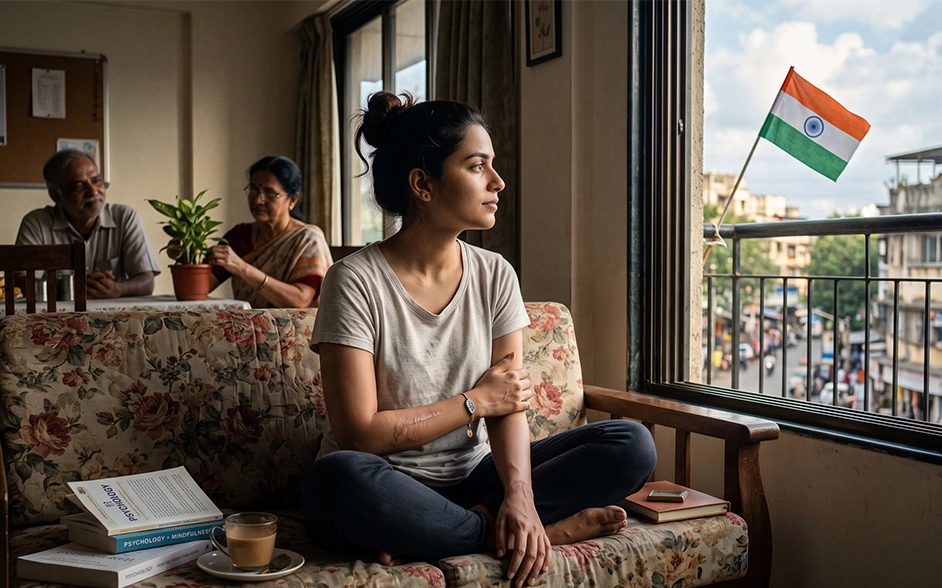
Every August, the tricolour goes up on balconies, schools sing the same songs they’ve sung for decades, and the country pauses to remember what it took to become free. It’s a good moment to ask an uncomfortable question: for millions of Indians, what would azaadi from mental illness or addiction actually look like and how far are we from it?
Political independence was won in a single moment in 1947. The independence that matters to someone living with untreated depression, or a family quietly managing a father’s drinking, doesn’t arrive in a single moment at all. It’s built slowly, through laws that finally recognise their dignity, through a shrinking distance between having a problem and getting help for it and through a home where a difficult truth can finally be said out loud.
India carries one of the widest mental health treatment gaps in the world. Over 150 million Indians need active mental health support, yet fewer than 10 to 15% receive any form of care, leaving an overall treatment gap of 83 to 85%. For alcohol use disorder specifically, the picture is just as stark: roughly 16 crore Indians consume alcohol, over 5% are dependent, and only 2.6% of alcohol-dependent individuals ever receive treatment, a treatment gap of 86.3%.
Part of this gap is infrastructure. India has roughly 9,000 psychiatrists for a population of 1.4 billion, far below what the World Health Organization considers adequate. But a large part of it is something less visible than a shortage of doctors: the quiet, inherited belief that struggling with your mind, or with a substance, is something to hide rather than something to treat. Stigma has kept generations of Indians from ever reaching the doorstep of help, let alone through it.
Here’s something worth knowing this August: India’s relationship with mental illness has already gone through its own quiet revolution in law, even if most citizens have never heard of it.
Until 2018, someone who attempted suicide in India could legally be prosecuted and imprisoned for up to a year under Section 309 of the Indian Penal Code. The Mental Healthcare Act, 2017, which came into force in 2018, changed this fundamentally. Under Section 115 of the Act, anyone who attempts suicide is now legally presumed to have been under severe stress and cannot be prosecuted or punished. The government instead carries a legal duty to provide care, treatment, and rehabilitation. This is, in the truest sense, a form of azaadi: freedom from being treated as a criminal for suffering.
The Act goes further than that single provision. It establishes mental healthcare as a legal right rather than a discretionary service, guarantees free treatment for those who are homeless or below the poverty line, requires insurers to cover mental illness on par with physical illness, and gives individuals the right to make advance directives about their own care. It is, on paper, one of the more progressive mental health laws in the world. The gap that remains isn’t in the law itself, but in how few Indians know these rights exist, and how unevenly the Act has been implemented on the ground.
For someone in the grip of addiction, azaadi carries a very literal meaning: freedom from a substance that has taken over decision-making, relationships, and self-respect. But real freedom from addiction rarely arrives through willpower alone. India’s own data on dual diagnosis shows that between 32% and 74% of people in addiction treatment also carry a co-occurring mental health condition, most often depression, anxiety, or trauma. Treating the addiction while ignoring what sits underneath it is treating half the problem, and it’s one of the most common reasons freedoms from a substance doesn’t hold.
Genuine addiction freedom in India increasingly looks like integrated care: a treatment plan that addresses the substance use and the anxiety or depression driving it at the same time, rather than one after the other. It looks like families learning, often through structured approaches like CRAFT, how to support a loved one toward treatment instead of either enabling the addiction or cutting them off entirely. It looks like earlier intervention, before a crisis forces the issue.
Azaadi from mental illness or addiction rarely arrives as a single dramatic moment, in the way independence did in 1947. It looks like a young professional in Bengaluru finally telling a therapist about the anxiety they’ve managed alone for years. It looks like a mother in Delhi
admitting to her own doctor that the sleeping pills prescribed years ago have become something she can’t stop. It looks like a family in Chennai sitting down together, without shame, to talk honestly about a father’s drinking for the first time.
None of these moments make it into a national narrative the way 1947 did. But collectively, they are what a freer, healthier India actually looks like, one honest conversation, one course of treatment, one family that stops organising itself around silence, at a time.
India’s mental health and addiction treatment gap won’t close through policy alone, even good policy like the Mental Healthcare Act. It closes when individuals and families decide their own azaadi from silence and suffering is worth pursuing, and when they know both their legal rights and the treatment options available to them. That decision, more than any law, is where independence actually begins.
Sources referenced: National Mental Health Survey of India, NIMHANS (2015–16); National Survey on Extent and Pattern of Substance Use in India, NDDTC-AIIMS (2019); Mental Healthcare Act, 2017, Government of India, Section 115; multicentre Indian dual diagnosis studies, Indian Journal of Psychiatry (2024); WHO mental health workforce standards.
It refers to the freedom from stigma, untreated illness, and legal punishment that has historically surrounded mental health in India. This includes both the legal protections under the Mental Healthcare Act, 2017, and the personal freedom that comes from accessing treatment rather than suffering in silence.
The Act recognises mental healthcare as a legal right, decriminalises suicide attempts under Section 115, guarantees free treatment for homeless and below-poverty-line individuals, requires insurance parity with physical illness, and allows individuals to make advance directives about their own care.
Since a significant share of people with addiction in India also have a co-occurring mental health condition, genuine and lasting addiction freedom usually requires integrated treatment that addresses both the substance use and the underlying anxiety, depression, or trauma at the same time.
The gap comes from a combination of infrastructure shortage, roughly 9,000 psychiatrists for 1.4 billion people, and deep-rooted stigma that keeps people from seeking help even where services exist. Many Indians also remain unaware that the Mental Healthcare Act grants them specific legal rights.
Recovery from mental illness or addiction is often described as a personal independence, freedom from a condition that has controlled decisions, relationships, and daily life. Unlike political independence, it tends to arrive gradually, through treatment, honest conversations, and sustained support rather than a single moment.
August’s association with independence offers a natural moment to reflect on a different kind of freedom, one from stigma, untreated illness, and silence around mental health and addiction, encouraging conversations that might not otherwise happen.

Comments are closed