Aftercare and Relapse Prevention:
Your Complete Guide to Life After Rehab in India


Completing a residential rehabilitation programme is one of the most courageous things a person can do. But if you are the person
who just left treatment — or the family waiting at home — you may already sense that discharge is not the finish line.
It is, in many ways, the beginning of the harder stretch.
The weeks and months after rehab are when recovery is most vulnerable. They are also when the right support makes the biggest
difference. This guide explains what aftercare looks like, what relapse warning signs to watch for, what to expect at each milestone
and how Veda stays with you and your family long after the residential programme ends

What is Aftercare and Why Does It Matter So Much?

Aftercare is the structured support a person receives after completing residential treatment. It can include follow-up counselling sessions, psychiatric check-ins, peer support groups, family therapy, relapse prevention planning and regular contact with their treatment team.

According to the National Institute on Drug Abuse (NIDA), relapse rates for substance use disorders are between 40% and 60%. For alcohol use disorder specifically, rates can be as high as 75–85% among those without structured aftercare.


These numbers are not meant to frighten — they are meant to contextualise. Addiction is a chronic condition, not unlike diabetes or hypertension, which carry their own relapse rates of 50–70%. Managing it long-term requires ongoing support, not a single course of treatment.
The good news: structured aftercare meaningfully reduces relapse rates. People who remain connected to support systems in the months after discharge are significantly more likely to sustain recovery. The first 90 days after leaving residential treatment are the most critical window. Every week of sustained recovery within that window builds neurological and behavioural resilience that compounds over time.

In India, where the overall mental health treatment gap sits at 83–85% and only 2.6% of alcohol-dependent individuals have ever received any formal treatment, aftercare is even more critical. When someone completes a programme, they have often become an outlier in their community. This is why Veda’s aftercare programme is not an optional add-on. It is designed as a continuation of care.

What Aftercare Looks Like at Veda?

Veda’s aftercare programme begins before discharge. In the final phase of the residential programme, the clinical team works with each client and their family to build a personalised aftercare plan — a clear, practical document that outlines what support will look like in the weeks and months ahead. 

Regular psychiatric follow-up

Clients are connected with a psychiatrist for ongoing check-ins at defined intervals after discharge. For dual diagnosis clients — those managing both addiction and a co-occurring mental health condition like depression or anxiety — this continuity of psychiatric care is clinically essential.

Individual therapy sessions

One-on-one sessions with a counsellor continue after discharge, typically shifting from weekly to fortnightly to monthly as stability is established.

Family counselling

Recovery does not happen in isolation. Family members often carry their own stress and unintentional patterns that can either support or undermine recovery. Veda's aftercare includes dedicated family sessions

Peer support and group connections

Clients are connected with peer networks and support groups appropriate to their situation, including anonymous fellowships where relevant.

A named point of contact.

Every client discharged from Veda has a named person they can call — not a general helpline, but a specific, known individual in Veda's clinical team.

Crisis protocol

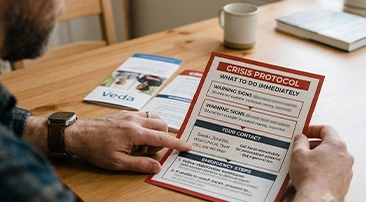
Every aftercare plan includes a clear, written protocol for what to do if warning signs emerge or if relapse risk increases. There is no ambiguity about who to call or what steps to take.

The 30 / 60 / 90 Day Milestones: What to Expect

The first 90 days after leaving residential rehabilitation are the period of greatest vulnerability — and of greatest gain if
navigated well. Here is what each milestone typically looks like.

Milestone What Typically Happens What Helps Most
Days 1–30
The Adjustment
Structure of residential care disappears.
Cravings most frequent. Old environments
trigger memories. Identity feels uncertain.
Hold to daily schedule. Maintain all clinical
contacts. Lean on family aftercare plan. Be
honest about difficult feelings.
Days 31–60
Establishing Rhythm
Daily rhythm begins to form. Many return
to work or social life. Risk: overconfidence
leads to skipping appointments.
Maintain all appointments even when things feel
stable. Build one recovery routine into every
week. Continue family counselling.
Days 61–90
Building Confidence
Brain neuroplasticity actively consolidating
new pathways. Sleep more stable. Emotional
regulation improving. Trust-rebuilding begins.
Recognise 90 days as a milestone, not a
graduation. Keep clinical contact. Allow trust
to rebuild at its own pace.

Days 1–30:
The Adjustment

The first month is the most disorienting. The structure of residential treatment disappears overnight. Real life rushes back in: family expectations, workplace pressures, the physical familiarity of old environments and old triggers. This is the period when cravings are most frequent and when the risk of relapse is statistically highest. Many people in early recovery describe this period as feeling like they are simultaneously a different person and exactly the same person.

What helps most
holding to a daily structure, maintaining every scheduled clinical contact, not making major life decisions and being honest — especially about the difficult things. Families should check in regularly without interrogating.

Days 31–60:
Establishing Rhythm

By the second month, the initial shock of transition typically settles. A daily rhythm starts to form. Many people return to work or begin rebuilding social lives. This is also when overconfidence can become a subtle risk. Feeling stable is real progress — but stability in early recovery can create a false sense that ongoing support is no longer necessary. Reducing or skipping aftercare appointments at this stage is one of the most common precursors to relapse.

What helps most
maintaining all clinical appointments even when things feel fine, building at least one recovery-related routine into every week and continuing the family counselling that helps everyone in the household adjust.

Days 61–90:
Building Confidence

The third month is when sustainable recovery patterns begin to consolidate. The brain's neuroplasticity — its capacity to form new pathways and reduce dependency on old chemical rewards — is actively working in the individual's favour. Sleep is often more stable. Emotional regulation is typically more consistent. The 90-day milestone is significant but not a graduation. Think of it as the point at which the most acute phase of post-discharge vulnerability is behind you — not the point at which support is no longer needed

Warning Signs of Relapse: What Families Need to Know

Relapse rarely happens suddenly. It unfolds in stages — and the earlier those stages are recognised, the easier it is to
intervene before a crisis develops.

Stage 1: Emotional Relapse
The person is not thinking about using. But their emotional state and behaviours signal that something is shifting. Warning signs at this stage include:

  • Withdrawing from family, friends or support networks
  • Mood swings, irritability or unexplained low mood
  • Poor sleep or disrupted routines
  • Neglecting meals or physical health
  • Skipping therapy or missing clinical appointments
  • Dismissing the aftercare plan (‘I don’t need this anymore’)
  • Bottling up emotions rather than talking about them

Stage 2: Mental Relapse
The internal battle begins. The person may start to romanticise past substance use — remembering the relief and minimising the consequences. Warning signs include:

  • Talking about old friends or environments associated with substance use
  • Becoming vague or evasive about their whereabouts
  • Minimising how serious the situation became (‘I wasn’t that bad’)
  • Rationalising why one occasion would be manageable

Stage 3: Physical Relapse
This is actual return to substance use. By the time this stage is reached, the emotional and mental groundwork has usually been laid over days or weeks

Intervention at Stage 1 or Stage 2 is far more straightforward than intervention after physical relapse has occurred. If you are noticing Stage 1 signs, contact the clinical team. You do not have to wait for certainty.

What Not to Do When You Spot Warning Signs

  • Do not accuse or confront in anger — this increases shame, which is itself a relapse trigger
  • Do not enable by covering up or making excuses for the person
  • Do not ignore what you are observing and hope it passes
  • Do not manage it alone — reach out to the clinical team immediately

Family Support: Your Role in Long-Term Recovery


If someone you love has completed treatment, your role in their ongoing recovery is more significant than you may realise — and more nuanced
than simply ‘being supportive.’ Recovery changes the relational dynamic in a family. Old patterns, enabling behaviours, communication habits and
emotional roles all need to shift. This adjustment is real and it takes time for everyone not just the person in treatment.
 Veda’s family support resources include:


Family counselling sessions:
Sessions built into the aftercare programme — structured sessions where the family system, not just the individual, does the work of adjustment


Education about addiction as a medical condition:
 Understanding that addiction involves measurable changes in brain chemistry — that it is not a choice or a character flaw — is one of the most powerful things a family can do to reduce shame in the home environment.


Guidance on enabling vs.
supporting:

These two things look similar from the outside. Veda’s clinical team works with families to identify specific patterns and develop healthier responses.


Support for family members themselves:
Caring for someone through addiction and recovery takes an enormous toll. These are legitimate clinical concerns and addressing them is part of the same work — not a distraction from it.

We will never ask you to come in for a consultation before telling you whether our programme is within your range. If it is not, we will tell
 you clearly and help you find an appropriate alternative.

How to Stay Connected with Veda After Discharge

Leaving Veda does not mean leaving Veda’s clinical network. Here is how we stay connected with clients and families

Scheduled follow-up calls

At defined intervals in the first 90 days, Veda's clinical team initiates contact — a structured, clinical check-in, not a courtesy call.

Your named aftercare contact

Every discharged client has a specific individual in Veda's team they can reach directly. Not a general inbox. A person

Ongoing outpatient sessions

Individual therapy and psychiatric follow-up continue on an outpatient basis — in person at Veda's centres in Mumbai, Delhi, Bangalore or Sikkim or via video for those who have returned to other cities.

Family sessions

These continue as part of the aftercare plan, with frequency adjusted based on need.

Open-door policy for concerns

If a family member is worried — even if they are not sure whether their concern is serious enough to raise — they can call. We would rather hear from a family that turns out to be fine than not hear from one that needed support.

Re-admission pathway

If a client needs to return to residential care, their existing clinical history means they are not starting over. The pathway back is direct and non-judgmental.

The First Step After the Last Day of Treatment

Leaving residential treatment is a significant achievement. What comes next is not less important — it is differently important. The structure changes, but the support does not have to.
If you or someone in your family has recently completed treatment, or is preparing for discharge, Veda’s clinical team is here to help plan what comes next.

Frequently Asked Questions

How long does aftercare after rehab last in India?

Aftercare duration varies by individual, but a meaningful aftercare programme in India typically runs for a minimum of six months post-discharge, with many clients maintaining clinical contact for 12 months or longer. The most critical period is the first 90 days, but longer engagement with structured support is consistently associated with better long-term recovery outcomes.

Globally, relapse rates for substance use disorders are estimated at 40–60% within the first year. Among those without structured aftercare, rates for alcohol use disorder specifically can be higher. In India, where peer recovery networks are less established and stigma remains a significant barrier, structured clinical aftercare is especially important. These figures reflect addiction’s nature as a chronic condition, not the failure of treatment. Structured aftercare meaningfully reduces these rates.

The earliest signs of relapse are emotional, not physical. Watch for withdrawal from family and support networks, skipping therapy appointments, mood instability, disrupted sleep, poor self-care and dismissiveness about the aftercare plan. These signs appear before any substance use occurs — which is exactly why recognising them early allows for intervention before the situation escalates.

No. Addiction is classified medically as a chronic, relapsing condition — comparable in its relapse rates to diabetes and hypertension. A relapse is a clinical event that indicates the treatment plan needs adjustment, not that recovery is impossible. What matters is how quickly it is recognised and what response follows.

Veda’s aftercare extends to the whole family system. Family counselling sessions continue post-discharge. Families have a named point of contact in Veda’s clinical team. We provide education on addiction, enabling patterns and what healthy family support looks like in practice. Family members who are themselves struggling with the stress of caring for someone in recovery can also access support through Veda.

Yes. Veda’s approach to relapse is clinical and non-judgmental. If a client who has previously completed a Veda programme needs to return to residential care, their existing clinical history is known to the team. There is a clear, direct re-admission pathway and the experience of returning does not start from zero.

Yes. Veda’s aftercare includes video-based individual therapy and psychiatric consultations, which means clients who have returned to cities other than Mumbai, Delhi, Bangalore or Sikkim can maintain their clinical connections remotely. Your named aftercare contact and scheduled follow-up calls continue regardless of where you are based.