- Mumbai, Gangtok, New Delhi, Bangalore
- (+91) 81518 30000
- WhatsApp Now
- contact@vedawellnessworld.com
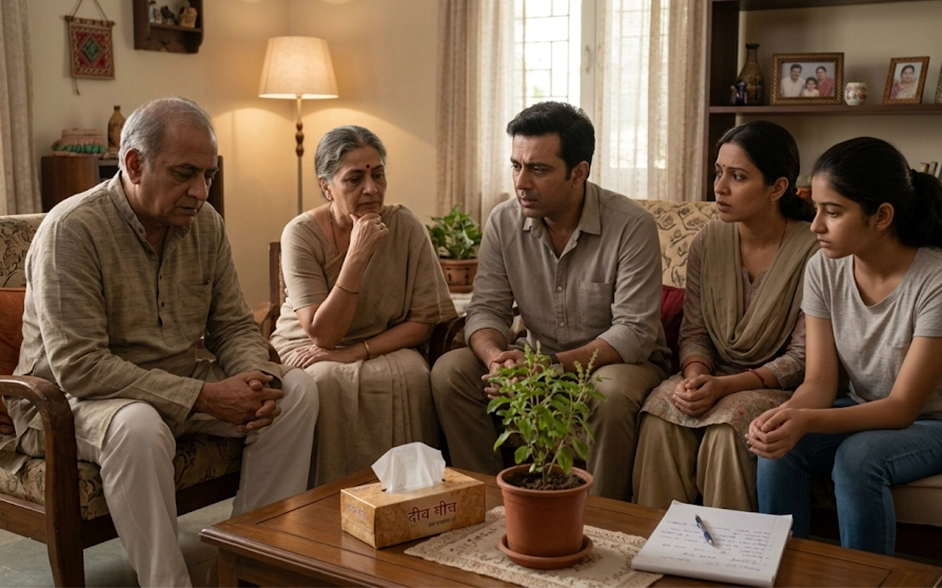
If you are reading this, chances are you have already spent many sleepless nights worrying about someone you love. Maybe it is a husband who has started drinking every evening. Maybe it is a son who has disappeared into his room and into a habit you do not fully understand. Maybe it is your sister, your father, your closest friend.
You are not alone and you are not overreacting. According to the National Survey on Extent and Pattern of Substance Use in India (2019), around 16 crore Indians consume alcohol and over 5.7 crore are estimated to be living with harmful or dependent use. Yet only about 2.6% of alcohol-dependent people ever receive treatment. The gap between those who are suffering and those who get help is enormous, and families are almost always the ones who close it first.
This guide is about how to do an intervention in India in a way that is honest, loving and effective. No drama. No shame. Just a clear path forward.
An intervention is a planned, caring conversation in which family and close friends come together to help someone recognise that their drinking or drug use is hurting them, and to offer them a real way out, usually treatment.
It is not an ambush. It is not a lecture. And it is not about blame. The goal of any good addiction intervention guide is simple: to move your loved one from “I don’t have a problem” to “Okay, I’m willing to get help.”
People often imagine the dramatic, surprise-style confrontation they have seen on television. In real life, especially in Indian families where relationships are layered with respect, duty and emotion, the gentlest approaches tend to work best. The point is connection, not cornering.
An intervention matters because addiction rarely fixes itself. The person caught in it is often the last to see how deep it has gone. That is not weakness or stubbornness, it is part of how the condition works.
Many families wait far too long. There is a quiet hope that things will improve on their own, that the next festival, the next job or the next promise will be the turning point. Often it is not.
The right time to stage an intervention is before a crisis not after one. Clinical experience consistently shows that earlier treatment produces better outcomes. Sadly, India’s mental health treatment gap sits at roughly 83–85% meaning the vast majority of people who need care are not getting it, usually because everyone waited for things to get “bad enough.”
Here are signs it may be time to act if you are wondering how to help an addicted family member in India:
That last point matters. In Indian treatment settings, studies report that between 32% and 74% of addiction patients also have a mental health condition such as depression or anxiety. Substance use is often a way of coping with pain that started earlier. The right time, then, is whenever you notice the pattern, not whenever it becomes undeniable.
If you take only one thing from this addiction intervention guide, let it be this: the loud, confrontational “surprise intervention” is not the most effective method. The evidence points somewhere far gentler.
The CRAFT model Community Reinforcement and Family Training, was developed by Dr. Robert Meyers and Dr. Jane Ellen Smith at the University of New Mexico. Instead of confronting the person, it trains the family to change how they respond, communicate and reward healthy behaviour, so that getting help starts to feel like the person’s own choice.
The results are striking. Across multiple studies, CRAFT engaged an average of about 7 out of 10 treatment-resistant loved ones into getting help. Compare that to the traditional confrontational “Johnson method,” which engaged roughly 30% and 12-step family approaches like Al-Anon, which engaged closer to 13–18%. In short, kindness works better than confrontation, by a wide margin.
Here is how to do an intervention the CRAFT way, step by step:
The words you choose can open a door or slam it shut.
What to say:
Speak from your own feelings using “I” statements. Be specific and gentle: “I noticed you’ve been drinking every night this month, and it scares me,” lands far better than “You’ve become an alcoholic.”
What to avoid:
This is especially delicate when planning an intervention for an alcoholic husband or a drug intervention in India, where pride, financial fear and “what will people say” all sit heavily in the room. Remember that beneath the defensiveness is often someone who is exhausted and ashamed. India recorded the highest workplace burnout rate in the world at 59% in one major global survey, and for many, substances begin as a way to cope with that crushing pressure. Compassion is not softness. It is strategy.
Sometimes love and good intentions are not enough on their own, and that is not a failure. An intervention specialist in India is a trained professional who guides the family, plans the conversation, manages strong emotions in the room and arranges immediate admission to treatment if the person says yes.
This professional support matters even more given how thin India’s resources are stretched: the country has only around 9,000 psychiatrists for a population of 1.4 billion with many states having fewer than one psychiatrist per lakh people. A specialist helps you navigate this gap and avoid common mistakes that cause interventions to backfire.
Consider professional drug intervention services in India when there is a risk of aggression, when the person has relapsed before, when there is a serious mental health condition alongside the addiction, or simply when the family feels too overwhelmed to do it alone. Having an expert in the room often makes the difference between “no” and “I’ll go.”
Getting a “yes” is the beginning, not the end. The hours right after an intervention are precious, because willingness can fade quickly. Ideally, treatment should be arranged in advance so your loved one can begin the same day they agree.
What comes next usually includes medically supervised detox if needed, followed by therapy that treats the whole person. This is crucial. Because so many people have a co-occurring mental health condition, the best programmes treat addiction and mental health together not one after the other. Treating them separately consistently produces worse outcomes.
Family involvement continues, too. Recovery holds far better when the home environment changes alongside the individual. Relapse, if it happens, is not the end of the story, it is information about what support is still missing.
At Veda Rehabilitation & Wellness, we have walked beside many families standing exactly where you are now, frightened, tired and unsure whether to act. We believe families deserve guidance, not judgment.
Veda offers integrated, evidence-based care for addiction, mental health and dual diagnosis across our centres in Mumbai, New Delhi, Bangalore and Sikkim. Our teams help families plan compassionate interventions, support the transition into treatment and stay involved throughout recovery, so the person you love is treated as a whole human being, with dignity, not as a problem to be managed.
If someone you love is struggling, please do not wait for the crisis. The most caring thing you can do is to reach out, for them and for yourself.
Plan ahead, stay calm and avoid blame. Use the CRAFT approach, positive communication and the right timing engage about 7 in 10 people, far more than confrontational methods. When in doubt, involve a professional.
Choose a sober, quiet moment, speak from love using “I feel” statements, and have a treatment option ready. Avoid ultimatums and arguing. Many families find that an intervention specialist makes the conversation safer and more effective.
Early on, you may feel restless, anxious, bored or even “phantom” phone buzzes, all signs your brain is adjusting. Within a few days, most people notice better sleep, calmer mood and sharper focus.
Refusal is common, not final. Keep the relationship warm, stop shielding them from natural consequences, and keep offering help calmly. CRAFT was designed specifically for loved ones who initially say no.
The core principles are the same, compassion, planning and a clear path to treatment. The main difference is medical: certain drugs may require supervised detox, which is one more reason to arrange professional care in advance.
Ideally, treatment begins the same day, often with detox followed by integrated therapy that addresses both addiction and any underlying mental health condition together.