- Mumbai, Gangtok, New Delhi, Bangalore
- (+91) 81518 30000
- WhatsApp Now
- contact@vedawellnessworld.com

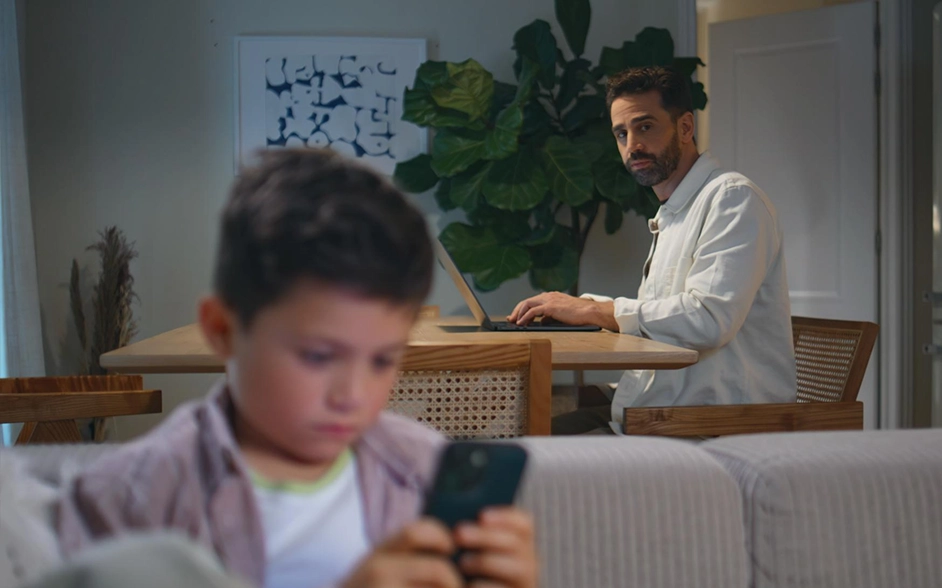
You’ve seen it. The glazed eyes. The thumb that scrolls on its own. The way a simple “beta, dinner’s ready” can spark an argument that ends with a slammed door. You watch your bright, funny, affectionate child disappear into a glowing rectangle for hours, and emerge irritable, tired and somehow further away from you than before.
If this is your home, please know two things. First, you are not failing as a parent. Second, you are absolutely not alone. Screen addiction in children across India has become so widespread that the government itself has named it a national health crisis. This guide is here to help you understand what’s really happening inside your child’s brain, and what you can actually do about it.
Here’s the truth that should make every parent angry: your child isn’t weak and you aren’t lax. The apps were built to be impossible to put down.
Reels, YouTube Shorts and Instagram feeds are engineered by teams of experts whose entire job is to capture and hold human attention for as long as possible. The mechanism is a brain chemical called dopamine, the chemical of anticipation and reward.
Every time your child pulls to refresh a feed, they don’t know what they’ll get. Maybe a hilarious clip. Maybe a friend’s like. Maybe nothing. That uncertainty is the trap. Unpredictable rewards trigger far more dopamine than predictable ones, it’s the same principle that makes gambling machines so addictive. Short videos make this worse: each clip is only seconds long, so the brain gets reward after reward after reward, faster than it can ever get from a book, a conversation or homework.
A developing teenage brain is especially vulnerable, because the part that controls impulse and self-discipline isn’t fully formed until the mid-twenties. So, when we tell a 14-year-old to “just put the phone down,” we’re asking an unfinished brain to win a fight against some of the most sophisticated engineering on earth. It’s not a fair contest, and that’s the point.
Teen social media addiction rarely begins as a problem. It begins as connection and fun.
It starts innocently, a phone for online classes, a few apps to chat with friends. Then the feed learns exactly what keeps your child watching and serves up an endless, personalised stream. Slowly, the screen becomes the first thing they reach for when bored, lonely, anxious or upset.
This is the part most parents miss: for many teens, the phone isn’t the root problem, it’s the bandage. A child already feeling anxious, low or left out discovers that scrolling numbs the discomfort. The screen becomes a way to self-medicate feelings they can’t yet name or talk about. Over time, the brain reorganises around the constant stimulation, real life starts to feel slow and dull by comparison, and the child needs more screen time just to feel “normal.” That is how a habit quietly hardens into a dependency.
This isn’t parental panic. It’s now official national concern. India’s Economic Survey 2025–26tabled in Parliament on 29 January 2026, formally flagged digital addiction as a major emerging public health challenge, especially for children and teenagers.
The figures are sobering:
The Survey linked heavy screen use to anxiety, depression, low self-esteem, cyberbullying stress, poor sleep, falling grades, and even warned of a connection to rising mental health distress. It recommended age-based limits on social media for children, stronger age verification by platforms, “phone-free” zones, device-free family hours and a Digital Wellness curriculum in schools. India currently sets no minimum age for social media, even though it is the world’s second-largest smartphone market and states like Goa and Andhra Pradesh have begun studying restrictions modelled on Australia’s under-16 social media ban.
In short: the screen time and mental health conversation in India has officially arrived. And it starts at home.
You don’t need every sign on this list. A steady pattern of several, especially the emotional ones, is worth paying attention to.
That last point matters most. A child who can put the phone away when asked is forming a habit. A child who genuinely can’tdespite real consequences, may be developing something closer to a dependency, and that deserves compassion, not punishment.
The goal isn’t to declare war on technology. It’s to help your child build a healthier relationship with it. Here’s what tends to actually work.
Start with connection, not confrontation. Before any rule, talk. Ask what they love about their apps and listen without lecturing. A child who feels understood is far more willing to cooperate than one who feels attacked.
Set screen-free zones and times, for the whole family. The dinner table, bedrooms at night and the first hour after waking are great places to start. The Economic Survey itself recommends device-free hours and phone-free zones. Crucially, this applies to everyoneincluding you.
Protect sleep fiercely. Charge all phones outside the bedroom overnight. Sleep is where teenage brains and bodies repair and the late-night scroll quietly steals it.
Be the example. Children copy what they see. If you scroll through dinner, no rule will hold. Modelling a calm, balanced relationship with your own phone is the most powerful tool you have.
Replace, don’t just remove. A screen fills time, soothes boredom and offers connection. Take it away and you must offer something in its place, sport, family outings, a hobby, time with friends or simply your attention.
Use age-appropriate limits. For younger children, the Indian Academy of Pediatrics recommends no screens at all under age 2, no more than one hour of supervised screen time for ages 2–5 and under two hours a day for ages 5–10. For teens, agree on reasonable limits together rather than imposing them.
Watch for the feeling underneath. If your child is scrolling to escape stress, sadness or loneliness, the screen is a symptom. Gently helping them name and face those feelings matters more than any app blocker.
Sometimes, despite your best and most loving efforts, the problem runs deeper than household rules can reach. That is not your failure, it’s a signal to bring in support, just as you would for any other health concern.
Consider professional help if your child shows signs of serious anxiety or depression, withdraws almost entirely from real life, becomes aggressive or distraught when offline or if their schooling, sleep and relationships are seriously suffering and nothing at home is shifting it. The World Health Organisation now formally recognises Gaming Disorder as a mental health condition and digital addiction treatment for children is a real, evidence-based field, not a sign that you’ve done something wrong.
At Veda Rehabilitation & Wellness in Mumbai, support for young people centres on understanding why the screen took hold. Care typically includes a full assessment that looks beyond screen time to any underlying anxiety or depression, evidence-based therapy such as Cognitive Behavioural Therapy (CBT), integrated dual-diagnosis care that treats the addiction and the mental health condition together and deep family involvement, because a child heals best within a supported family. Reaching out isn’t giving up on your child. It’s one of the most loving things a parent can do.
For young children, the Indian Academy of Pediatrics advises no screens under age 2, up to one supervised hour for ages 2–5, and under two hours a day for ages 5–10. For teens there’s no single magic number, but India’s Economic Survey notes children aged 12–18 now average over six hours daily, and warns that heavy use is linked to anxiety, depression and poor sleep.
While “screen addiction” isn’t yet a standalone diagnosis, the World Health Organisation recognises Gaming Disorder under ICD-11 and India’s Economic Survey 2025–26 treats digital addiction as a genuine public health concern. The dopamine-driven loops involved are very real.
Short videos deliver rewards every few seconds, triggering rapid bursts of dopamine that a developing teenage brain finds extremely hard to resist. The feeds are personalised by algorithms designed to maximise watch time, it’s engineered to be hard to stop.
Sudden, total bans often backfire, sparking conflict or secret use. Gradual limits, screen-free zones, protected sleep and replacing screen time with real-world activities tend to work far better, alongside open, non-judgemental conversation.
If your child shows signs of depression or severe anxiety, withdraws from real life, reacts with extreme distress when offline or if school, sleep and relationships are seriously affected despite your efforts at home, it’s wise to consult a professional. Early support makes a real difference.