Fantasy Sports Addiction in India: When the Game Becomes a Crisis

  • Home
  • Addiction
  • Fantasy Sports Addiction in India: When the Game Becomes a Crisis

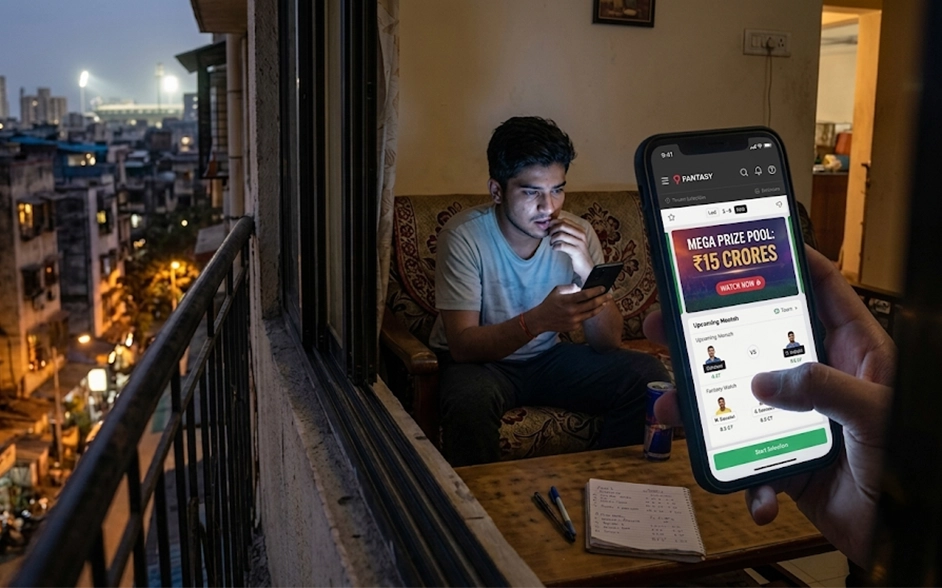
It rarely begins as a problem. It begins as fun. You pick a cricket team before the IPL match, put in a small amount and feel the thrill of every six and every wicket as if you were on the field. Then one match becomes every match. One small entry fee becomes a dozen. And one quiet evening you realise you’ve spent money you didn’t have, chasing a loss you can’t explain to anyone, least of all yourself. 

If that story feels too close to home, please keep reading. Fantasy sports addiction in India is real, it is medical and it does not disappear just because an app does. You are not foolish and you are not alone. Millions were pulled into the same current, and there is a way back.

India's Fantasy Sports Boom

For more than a decade, fantasy sports were one of India’s biggest digital success stories. Dream11, founded in Mumbai in 2008, turned cricket from a sport you watched into a game you played with real money. As cheap data and affordable smartphones reached every corner of the country, the user base exploded. 

The scale is staggering. India’s online gamers grew from around 36 crores in 2020 to more than 50 crores by 2024. Real-money gaming became a multi-billion-dollar industry, backed by global investors and advertised relentlessly during every cricket match by some of the country’s most loved celebrities and players. For a small entry fee, sometimes as little as ₹29, you could join a prize pool shared among thousands. 

What looked like harmless entertainment was, for a growing number of people, becoming compulsive. And the numbers the government later revealed showed just how deep the damage had gone. 

The 2025 Gaming Ban: What Changed, and What Didn't

In August 2025, Parliament passed the Promotion and Regulation of Online Gaming Act, 2025 the law most people now know as the online gaming ban India 2025. It cleared the Lok Sabha on 20 August, the Rajya Sabha on 21 August and received Presidential assent on 22 August 2025. 

The law was sweeping. It banned all online money games, whether based on skill or chance, including fantasy sports apps like Dream11, My11Circle and MPL, as well as online rummy and poker. It also banned their advertising and the financial transactions behind them. Breaking the law can mean up to three years in jail or a fine of up to ₹1 crore. At the same time, the Act actively promotes e-sports and casual, non-money social games. 

Why such a hard line? The figures the government cited were sobering. Speaking in Parliament, IT Minister Ashwini Vaishnaw said that an estimated 45 crore people were negatively affected by online money games, with losses of more than ₹20,000 crore every year. He called online money gaming a “public health menace,” linking it directly to addiction, financial fraud, and, in the most heartbreaking cases, suicides driven by gambling losses. 

Here is what changed: the apps went dark. Dream11 and others suspended their paid contests almost overnight. 

Here is what didn’t change: the addiction. A law can remove a platform from your phone, but it cannot remove the craving the platform wired into your brain. Worse, many people simply migrated to illegal offshore betting websites that ignore Indian law and offer no safeguards at all. The behaviour didn’t end. It went underground. That is exactly why understanding Dream11 addiction and behavioural addiction more broadly, matters more now, not less. 

Behavioural Addiction: The Clinical Definition

Here is the most important thing to understand: you do not need a substance like alcohol or a drug to develop a genuine addiction. The brain can become hooked on a behaviourand the science is clear about why. 

When you place a bet on a match, your brain releases dopamine the chemical of anticipation. The crucial trick is uncertainty: you don’t know if you’ll win, and that “maybe” keeps dopamine firing harder than a guaranteed reward ever could. It’s the same loop that drives slot machines. Over time, the brain needs bigger bets and more frequent play to feel the same rush, while everyday life starts to feel flat. That is a clinical pattern, not a character flaw. 

The World Health Organisation recognises Gaming Disorder in its International Classification of Diseases (ICD-11), describing it as a pattern of play marked by loss of control, putting gaming ahead of other activities and continuing despite clear harm. Gambling Disorder is similarly recognised as a behavioural addiction by clinicians worldwide. In India, awareness of gambling disorder in India is only now catching up with how widespread the problem has quietly become. 

10 Warning Signs of Gambling Addiction

You don’t need to tick every box. A steady pattern of even a few of these signs deserves attention. 

  1. You bet more than you can afford and tell yourself you’ll win it back. 
  2. Chasing losses the urge to keep playing to recover money you’ve lost. 
  3. Failed attempts to stop you’ve quit before and slid back. 
  4. Restlessness or irritability when you try to cut down. 
  5. Preoccupation you’re constantly thinking about the next match or contest. 
  6. Lying about it to family or friends or hiding how much you play. 
  7. Borrowing money or selling things to fund your play. 
  8. Neglecting work, studies, or relationships because of gaming. 
  9. Using it to escape stress, sadness, anxiety or loneliness. 
  10. Relief through play feeling that gaming is the only thing that calms you. 

That last point matters most. In clinical practice, behavioural addictions very often sit alongside an underlying mental health condition, anxiety, depression or unresolved stress. The betting becomes a way to self-medicate the pain. Treating one without the other rarely holds. 

The Financial and Mental Health Impact

The harm from fantasy sports and online gambling addiction runs along two tracks that feed each other. 

The financial wound is brutal and fast. The government’s own estimate of ₹20,000 crore lost every year is not an abstract number, it is rent that went unpaid, savings that vanished, loans taken in secret and families pushed into debt they didn’t see coming. Unlike many addictions, gambling can wipe out a person’s finances in a single night. 

The mental health wound runs even deeper. The shame of mounting losses fuels anxiety and depression. Sleep collapses. Relationships strain under the weight of secrecy and broken promises. The government explicitly linked these platforms to severe psychological distress and, tragically, to suicides. When debt and despair combine, the danger becomes life-threatening, which is why early help is not a luxury but a necessity. 

If you or someone you love is feeling hopeless about gambling losses, please reach out to a mental health professional or a helpline right away. This is a moment to ask for support, not to face it alone.

Treatment Options at Veda

The good news that the headlines rarely mention: behavioural addiction is treatable. With the right support, the brain canheal, the cravings can ease and life can feel full again. 

At Veda Rehabilitation & Wellness in Mumbai, online gambling addiction treatment India is built around the whole person, not just the habit. Our approach to behavioral addiction rehab typically includes: 

  • A full clinical assessment that looks beyond the gambling to any underlying anxiety, depression or stress driving it. 


  • Cognitive Behavioural Therapy (CBT) to break the trigger-bet-reward loop and rebuild healthier responses to urges and setbacks. 
  • Integrated dual-diagnosis care treating the addiction and any co-occurring mental health condition togetheran approach that consistently produces better, longer-lasting outcomes than tackling them one at a time. 
  • Financial and family counselling because recovery has to repair relationships and rebuild trust, not just stop the behaviour. 
  • Relapse-prevention planning and aftercare so the progress made holds long after treatment ends. 

Recovery is not about willpower or shame. It is about understanding what happened in your brain, and getting real, structured help to change it. 

Frequently Asked Questions

Is fantasy sports addiction a real medical condition?

Yes. While “fantasy sports addiction” isn’t a standalone diagnosis, it falls under behavioural addiction, closely related to Gambling Disorder and the Gaming Disorder that the World Health Organisation officially recognises in ICD-11. It involves the same dopamine-driven loops seen in other addictions. 

Because the law removed the apps, not the addiction. The Promotion and Regulation of Online Gaming Act, 2025 banned real-money platforms, but the cravings remain wired into the brain and many users simply moved to illegal offshore betting sites. Treating the underlying behavioural addiction is what actually breaks the cycle. 

A hobby is something you enjoy and can stop. A gambling disorder is marked by loss of control, chasing losses, betting more than you can afford, lying about it and being unable to quit despite real harm to your money, mind and relationships. 

Often, yes. Therapies like CBT are central to behavioral addiction rehab. Medication may help when there’s a co-occurring condition like anxiety or depression, which is why a proper clinical assessment comes first. 

Veda Rehabilitation & Wellness offers confidential, evidence-based, integrated care for behavioural addictions and co-occurring mental health conditions. The first step is simply a private, judgement-free conversation about what you’re going through. 

Leave A Comment

Your email address will not be published. Required fields are marked *